Roofing in West Pittston comes with a question most valley boroughs never have to ask, and Scranton Quality Roofing raises it before any shingle is priced: does this house sit inside the mapped floodplain along the Susquehanna? On a riverfront lot, that answer changes how the borough looks at the job and how the owner should plan it. A roof that would be a simple swap elsewhere can become one line in a larger floodplain review here.
We have spent more than twenty years on roofs across the Scranton area and Luzerne County, and this borough is where the roof conversation so often starts with the river. Before replacement is ever mentioned, we tell the owner plainly whether the existing roof can be repaired. That answer carries extra weight on a house where every dollar of work may be weighed against what the building is worth.
Leak calls get the same treatment here as anywhere we work: a look in the attic as well as on the roof, so the water is traced to its real entry point. What differs is the paperwork around the work. Below we cover the 2011 flood, the borough’s flood insurance standing, the 50 percent rule and the levee plan, and where each one touches a roof.
September 2011: Tropical Storm Lee and the Flood of Record
The Garden Village, as the borough has long been called, sits right on the Susquehanna, and many households still measure its recent history by Tropical Storm Lee. The storm sent the river over its banks in September 2011, and the water reached more than a quarter of the town. For anyone buying, repairing or re-roofing a house near the river, that flood is still the reference point.
What the Wilkes-Barre gauge recorded
The USGS gauge that tracks this stretch of river sits downstream at Wilkes-Barre, and on September 9, 2011 it read 42.66 feet with a flow of 310,000 cubic feet per second. That crest topped the 40.91 feet recorded during Agnes in June 1972, the mark the valley had planned around for decades. Lee became the new flood of record at that gauge.
The figure is a river stage at Wilkes-Barre, not a depth of water at any West Pittston address. Still, it explains why the borough treats its floodplain so seriously. When a crest beats the one a generation of planning was built on, the maps, the insurance and the local rules all start to look at the river differently.
880 residences, 26 businesses, four churches
Reporting in the Times Leader and Dallas Post put the damage from the 2011 flood at $98 million, spread across 880 borough residences, 26 businesses and four churches. For a borough counted at 4,644 people in 2020, that reached a large share of its homes. Behind each of those numbers is a household that had to decide what to repair, what to replace and what to file.
Most of the housing here also predates any flood map. Of roughly 2,314 housing units counted by the Census, 1,129 were built in 1939 or earlier, long before the borough’s first flood insurance rate map took effect on April 15, 1977. Those are the houses the floodplain rules call pre-FIRM, the group the substantial improvement test was written for.
Why a ground-level flood matters to a roofer
A flood is a ground-level event, so it is fair to ask why a roofer cares. The reason is that a re-roof on a riverfront house is often planned alongside other repairs. Under the borough’s floodplain ordinance, that combined cost is what gets reviewed.
So we ask about the house’s flood history early, the same way we ask about past leaks. If drywall, wiring or mechanical work is also on the owner’s list, we say so before pricing. Knowing the full picture keeps a roof estimate from becoming the line that pushes a house into a review nobody saw coming.
Looking for roofing closer to Jenkins? See Roofing Services in Jenkins.
Class 7 in the Community Rating System
West Pittston entered the National Flood Insurance Program’s Community Rating System on May 1, 2020, and it holds a class 7 rating. FEMA’s Community Status Book lists the borough as community 420628B, with its current effective flood map dated June 20, 2024. Those details sound remote from a roof, but they shape how carefully the borough manages work in the floodplain.
What class 7 is worth to a policyholder
A class 7 rating carries a 15 percent discount on eligible flood insurance premiums in the borough. Communities earn that standing by managing their floodplains beyond the program’s minimum. The discount is a shared benefit, and it depends on the borough continuing to administer its floodplain rules.
For an owner along the river, that means the floodplain permit is not a formality. The rating rewards a community for following its own rules, so we plan riverfront jobs on the assumption that the review will happen. Building that time into the schedule is easier than explaining a stop order halfway through a tear-off.
The Floodplain Administrator’s role
The posted floodplain ordinance names the borough’s Zoning and Code Enforcement Officer as Floodplain Administrator, with the West Pittston Borough EMA acting when that position is empty. Section 2.02 makes it unlawful to undertake construction or development anywhere in the borough without a permit from that administrator. The posted copy is unsigned, with its number and adoption date left blank, so we treat it as a guide and confirm the current rule with the office.
The office itself is in transition. The borough posted a request for proposals for a third-party zoning and code enforcement officer on June 2, 2026, so the person reviewing a job may change within a season. We call Code Enforcement and Zoning at (570) 655-7785 before pricing rather than relying on last year’s contact.
Permits on the borough forms page
The borough’s forms page lists Building and Electrical, Mechanical and Plumbing, Dumpster, Contractor Registration and Public Right of Way applications, but no separate roofing form. That leaves the office to say which form a re-roof needs, and the answer can differ for a house inside the mapped floodplain. Every municipality we serve sets its own re-roof rule, and we check West Pittston’s for the specific address before the price is set.
A dumpster at the curb carries its own permit here, and most tear-offs need one. We line up that application with the roof permit so the container does not arrive ahead of the paperwork.
The 50 Percent Test and Where a Roof Fits
The part of the floodplain ordinance that matters most to a homeowner is Section 3.03 C. For existing structures, the Floodplain Administrator reviews the proposed cost of improvements or repairs against the pre-improvement market value of the building. That review produces a substantial improvement or substantial damage determination, and the outcome decides what the rest of the project must do.
How substantial improvement is defined
Under the posted text, substantial improvement is work whose cost equals or exceeds 50 percent of the structure’s market value before construction starts. A house that crosses that line is generally expected to meet current floodplain standards, which here use the base flood elevation plus 1 1/2 feet of freeboard. Meeting that elevation on an older house is a far larger project than any roof.
The value side of the test is the structure, not the lot. ACS figures put the median owner-occupied home value in West Pittston at $179,100. On a modest house, a broad renovation that includes a roof can approach half the building’s value faster than owners expect.
A re-roof combined with other repairs
On a house inside the mapped floodplain, roofing is part of the improvement cost the borough tallies, so a re-roof planned with other repairs on a riverfront house belongs in that count. Not every re-roof sets off a review, and whether a given house is in the floodplain is an address-by-address question. The posted text also shows no cumulative period, so we do not assume past work is added in.
What we do is ask what else is planned for the house this year. If siding, windows or interior flood repairs share the scope, the owner should hear about the 50 percent test from us before the borough raises it. Sometimes the sensible answer is a roof repair now and a replacement later, and we say so plainly.
Written scopes the borough can read
Our estimates list tear-off, decking, underlayment, flashing, ventilation and gutters as separate lines. That format lets an owner compare two bids item by item, and it gives the Floodplain Administrator a clear figure for the roof portion of a larger project. A single lump sum leaves everyone guessing which dollars belong to which repair.
Decking is where a roof’s cost can move after the job starts. When rotted sheets turn up under the old roof, we photograph them and show the owner before replacing anything, at a per-sheet price fixed in the contract. That keeps the final roof cost close to the figure the borough reviewed.
The Susquehanna Avenue Levee the Borough Is Still Pursuing
West Pittston has kept working toward flood protection of its own since the 2011 flood. A levee along Susquehanna Avenue is the borough’s current plan, and it remains a plan rather than a structure. Owners making roof decisions now should treat the river as unchanged until something is built.
Why the Army Corps passed on it
The Army Corps of Engineers concluded during 2017 that a West Pittston levee did not meet the benefit-to-cost ratio warranting the investment. That decision left the borough to pursue the project itself. Local reporting from September 2021 and again from January 2024 described the borough still pushing for funding.
What the plan would take
The plan calls for acquiring about 60 vacant parcels on the river side of Susquehanna Avenue. The levee height would vary up to a maximum of 15 feet, and the estimated cost runs from $50 million to $55 million. Reported grants include a federal award of $562,500 with a $187,500 county match, plus a $1.5 million Pre-Disaster Mitigation grant that needs a $500,000 local match.
Those figures describe a project still assembling its money. Until a levee is designed, funded and built, the flood map and the ordinance remain the rules a house lives under. We do not tell any owner their street is protected, because that has not been established.
Roofing well while the river question stays open
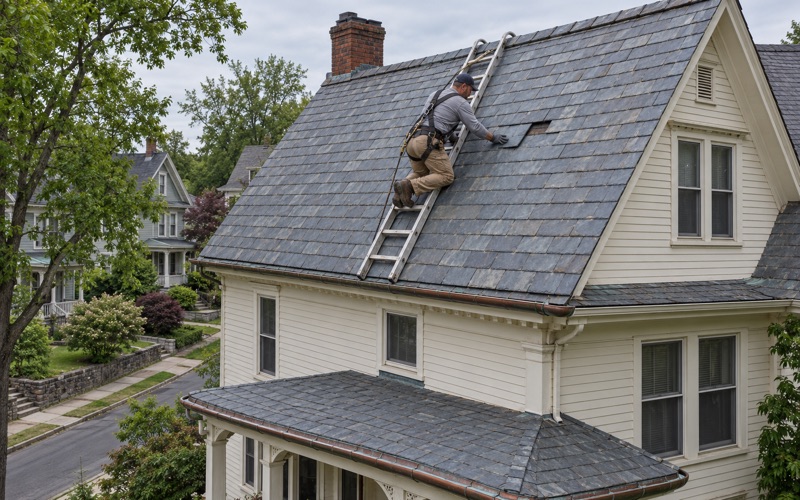
For now, the practical goal is a roof that does its job without adding to the owner’s floodplain burden. We inspect the attic and the roof surface together, so a leak is traced to its source before replacement comes up. Where a slate roof on an older house is sound, we repair it slate by slate with copper nails and slate hooks.
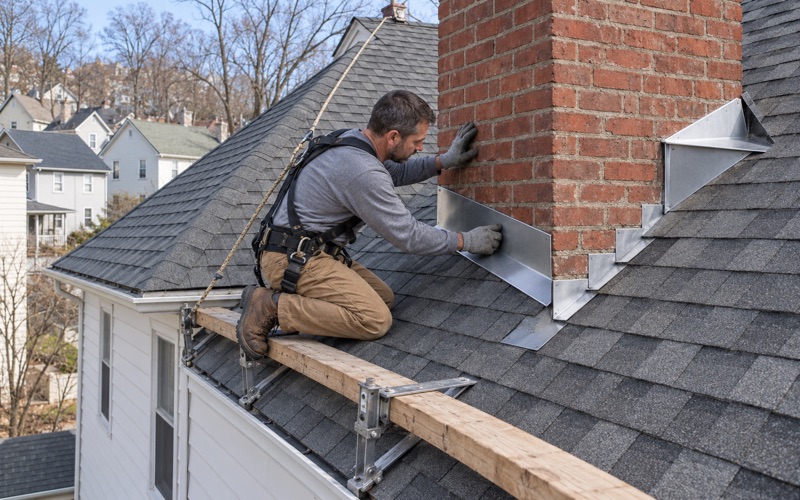
When a full replacement is the right call, step, counter and chimney flashing come off with the old roof and new flashing goes on with the new material. Gutters and downspouts are sized and pitched with the roof, which matters on a house where water is already on the owner’s mind. At the end of each work day the driveway, yard and gutters are cleaned, with a magnet sweep for nails.
- 20+ Years Roofing
- Free Written Estimates
- Repair Before Replace