Scranton Quality Roofing brings more than 20 years of roofing in Throop and the surrounding valley to every house we look at, and the first question we answer on any job here is what the borough expects before work begins. That question has a firmer answer now than it did a year ago, and it shapes how we price, schedule and start a roof.
We treat a roof as a whole system rather than a layer of shingles. When a homeowner calls about a leak, we check the attic as well as the roof surface, so the water is followed back to its real entry point before a number is ever written down. If the roof can be fixed, we say so plainly and stop there.
When replacement does make sense, the plan starts with paperwork rather than a tear-off date. The rest of this page explains how the borough’s permit rule works for homeowners, what we know and do not know about it, and how we build a Throop re-roof around it from the first visit.
Throop’s Roofing Permit Rule From January 1, 2026
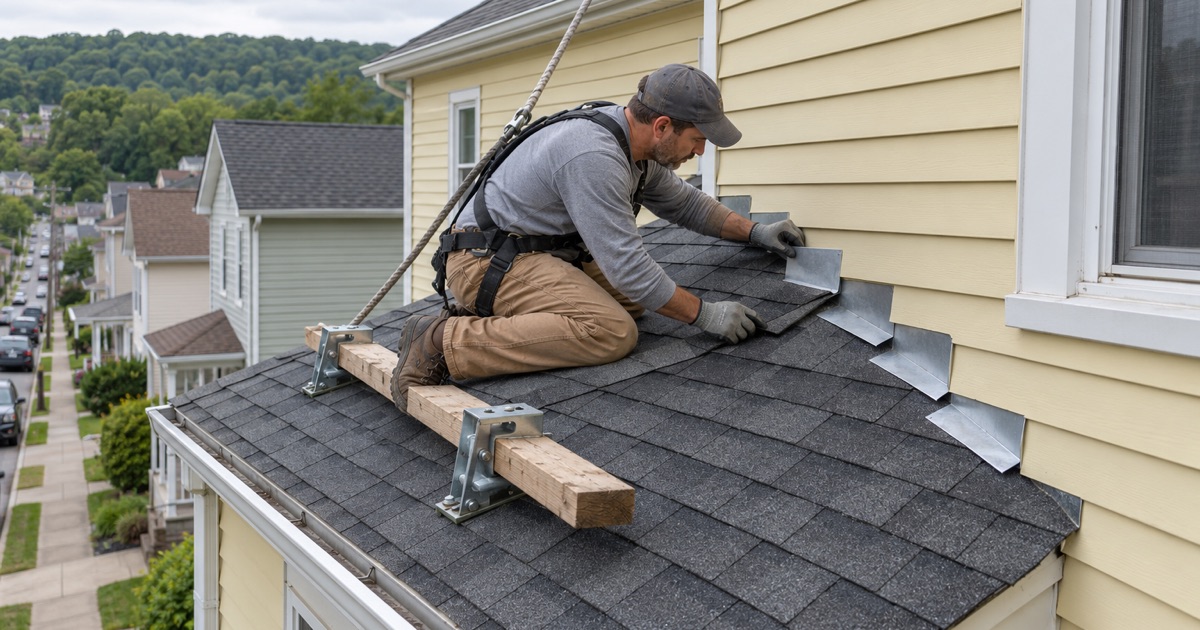
For years, plenty of homeowners in the borough treated a shingle replacement as work that needed no filing at all. Throop changed that at the start of 2026, and the change is spelled out in the borough’s own public notice rather than buried in a code book.
What the December 2, 2025 Notice Says
On December 2, 2025, the Borough of Throop released a notice titled “Roofing Permits are REQUIRED as of January 1, 2026.” The same headline has run across the news ticker on the borough’s website, so the message was not meant to be missed. Any Throop roof replacement planned for 2026 or later should begin with that permit.
A roofing contractor’s blog in the region reported the same thing independently, noting that the current requirement took effect January 1, 2026. Two separate sources saying one date is enough for us to treat the rule as settled. We plan every replacement in the borough as permitted work from the first conversation onward.
Why a Borough Can Ask for More Than the State
Pennsylvania’s Uniform Construction Code sets a statewide floor for permits, and it leaves some roofing work outside that floor. The same code allows a municipality to require permits for work the state would otherwise exempt. Throop chose to use that option for roofing, which is why a rule from another town does not answer the question here.
The state’s municipal records show Throop opted into the Uniform Construction Code on July 6, 2004, with no local amendments listed. That opt-in is what makes the borough responsible for administering building permits locally through its chosen inspection agencies. The 2026 roofing requirement sits inside that same local arrangement.
What the Notice Leaves for the Office to Answer
We have read the notice title and its release date, but not the full text behind it. That means the details a homeowner most wants to know are still questions for the borough itself. The fee, the inspection stages and the exact scope of work covered are not things we will guess at on a customer’s behalf.
The practical response is simple. Before we price a job, we check the current rule with the borough for that specific house and scope. The answer goes into the estimate as its own line, so nobody discovers a permit step halfway through a tear-off.
Looking for roofing closer to Dickson City? See Roofing Services in Dickson City.
Who Reviews and Inspects a Throop Roof Permit
Knowing a permit is needed is only half of the job. The other half is knowing which office takes the application and who comes out to look at the work, because those are the people who decide when a project can move forward.
The Borough Office on Sanderson Street
Permits go through the borough office at the municipal building, 436 Sanderson Street, Throop, PA 18512. The office can be reached at (570) 489-8311, and the borough’s zoning and code enforcement officer works out of the same building. This is the first stop for any question about whether a given roof project needs filing.
The borough’s own building permit submittal guide asks applicants for details such as roof rafter size, species and grade of wood, rafter spacing, and the thickness and type of roof sheathing. That checklist belongs to framing work in general. It does not prove a simple re-roof needs a full set of plans, so we confirm what the office wants for each job.
Two Third-Party Inspection Choices
Inspections for a Throop permit are handled outside the borough office itself. The borough’s permit sheet states that Throop Borough offers two third-party Uniform Construction Code inspection choices. A homeowner or contractor works with one of those agencies for plan review and inspections tied to the permit.
The borough sheet also notes that permits are generally required for most construction activities, including additions, renovations and structural changes. We ask the office which agencies are currently on its list when we apply. That keeps the project with an inspector the borough recognizes rather than one we assumed from an older job.
The $200 Late Fee for Work Started Early
A borough resolution sets a permit late fee of $200.00 for permits issued after construction has already started. That fee applies to Uniform Construction Code permits, which is the category a roofing permit falls under. Starting a tear-off before the paperwork is approved can add a cost that buys nothing.
This is the main reason we never set a start date until the permit is in hand. A delay of a few days while the application clears costs a homeowner far less than a late fee and an awkward conversation with the borough. The schedule we hand over always reflects the approval, not a guess about it.
Throop Houses and the Borough’s Own Roof
The permit rule lands on a particular kind of housing stock. Throop is a borough of 4.97 square miles adjoining Scranton, and its population was 4,078 at the 2020 census. The homes that population lives in carry a long history of coal mining and silk manufacturing work.
Half the Housing Predates 1950
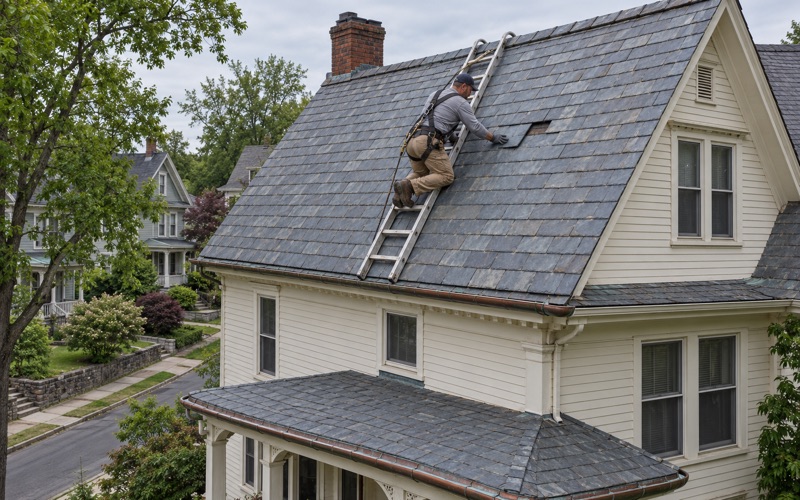
Census figures for the borough show that 53.8 percent of housing units were built before 1950. Of the borough’s roughly 2,097 units, 693 date from 1939 or earlier and another 435 from the 1940s. Many of those roofs have been covered, stripped and covered again over the decades, sometimes with layers that do not match.
Older framing is where our decking policy matters most. Once the old roof is off, any rotted or damaged sheathing is photographed and shown to the owner before a single board is replaced. The per-sheet price is fixed in the contract ahead of time, so a hidden problem does not become an open-ended bill.
Detached Homes Owned by the People Living There
Detached single-family houses make up 76.2 percent of Throop’s housing, and owners occupy 1,505 of the borough’s 1,903 occupied units. Most of the roofs we see here belong to the family that lives under them. Those owners are the ones filing permits, meeting inspectors and paying for the work.
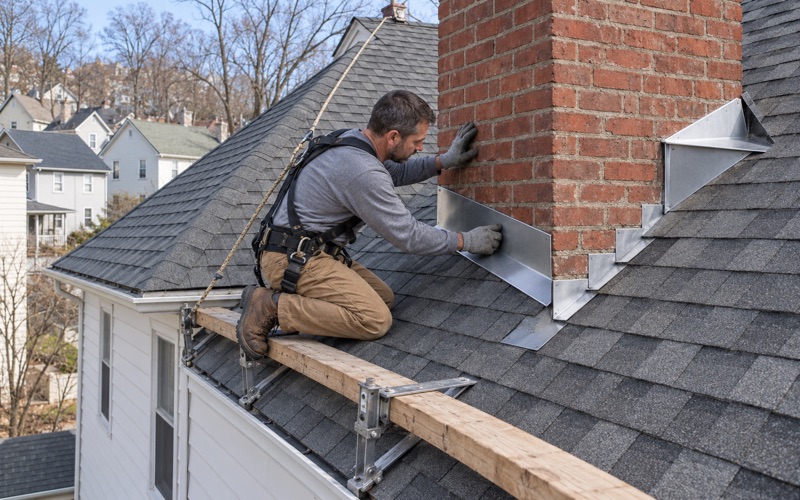
On these houses we replace step, counter and chimney flashing with the roof rather than reusing tired metal under new shingles. We also size and pitch gutters and downspouts together with the roof, since an older detached home often drains onto a neighbor’s lot or a narrow side yard.
The Borough Building’s Low-Slope EPDM Replacement
The borough has been dealing with its own roof as well. A 2022 resolution sought a Local Share Assessment grant for the demolition, repair and replacement of the Throop Borough Building roof. Council records from 2026 list payments of $45,061.20 and $46,773.53 for the Borough Building Low-Slope EPDM Roof Replacement Project.
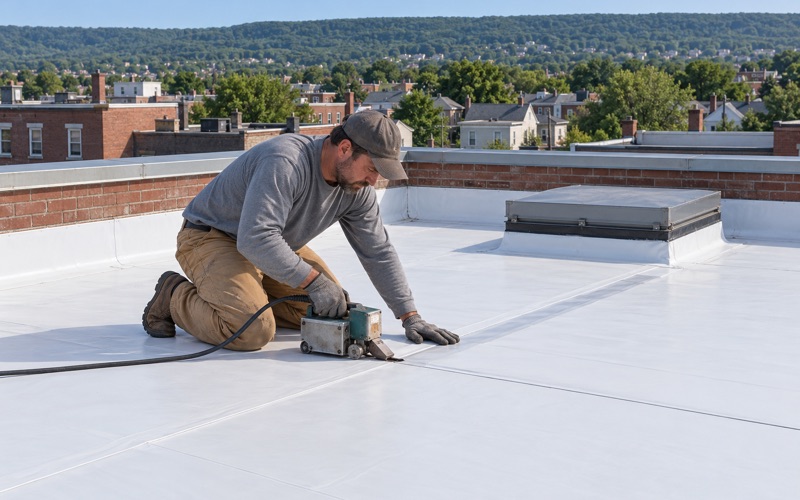
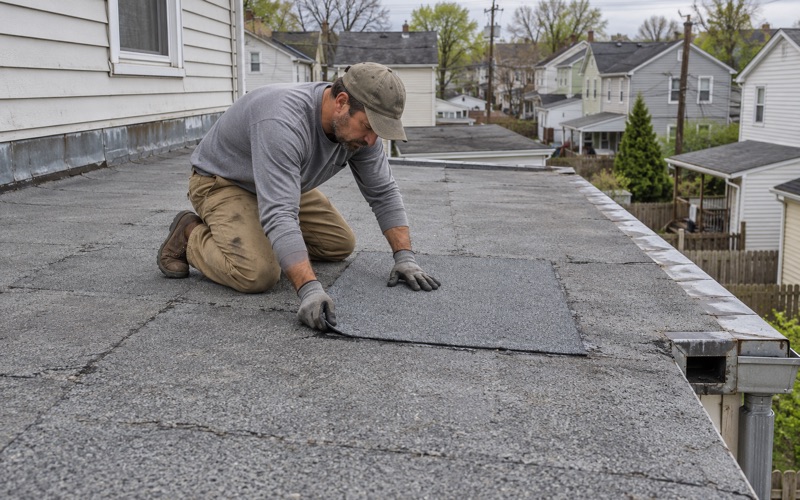
Council also approved $5,148.00 for professional services on the same project. That work was handled by its own contractor, not by us. It is a useful reminder that low-slope roofs on porches, additions and rear sections of Throop homes call for EPDM rubber membrane or similar systems rather than shingles.
Planning a Throop Re-Roof Around the Permit
With the rule in place, a well-run project here follows a predictable order. Inspection comes first, then a written scope, then the permit, and only then the tear-off.
An Honest Look Before Any Price
Every visit starts with the attic and the roof surface together. We trace moisture stains, check the sheathing from below and look at how flashing meets chimneys and walls. If a repair will solve the problem, we tell the owner that before replacement is ever on the table.
When the borough rule does apply, we check it for that address before pricing. A small repair and a full replacement can be treated differently, and we confirm with the office how the rule applies to the specific job rather than assuming.
A Scope Written Line by Line
Our written scope lists tear-off, decking, underlayment, flashing, ventilation and gutters as separate items. That format lets a Throop homeowner compare two estimates item by item and see exactly where the prices differ. It also gives the permit office and the inspector a clear description of the work.
At the eaves we install a self-adhering ice barrier sized to the actual overhang of the house. Contracts follow Pennsylvania’s home improvement law, with the three-business-day cancellation notice included and deposits kept within the legal limit.
Scheduling the Tear-Off After Approval
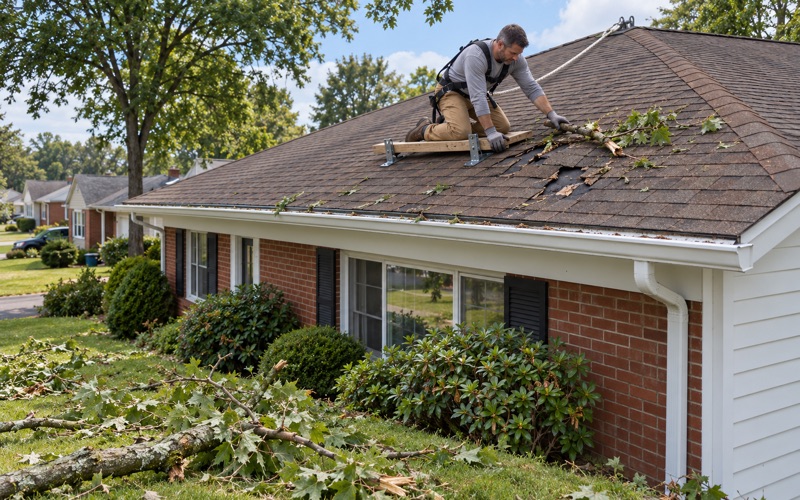
Once the permit is issued, we set the start date and coordinate any inspection the selected agency requires. The crew cleans the driveway, yard and gutters at the end of every work day, including a magnet sweep for loose roofing nails. Owners with storm damage get photos and a written report for their own claim, and we will meet the adjuster on site when asked.
The goal is a roof that passes review the first time and a project that never triggers a late fee. For a Throop homeowner planning a re-roof this year or next, the first call is to the borough office, and the second can be to us.
- 20+ Years Roofing
- Free Written Estimates
- Repair Before Replace