Townhouse roofing in South Abington often begins with a question that has nothing to do with shingles: who is allowed to make the call. For Scranton Quality Roofing, that question comes before any ladder goes up, because the answer changes who signs the contract and who pays. After more than 20 years working on roofs across the Lackawanna Valley, we treat the paperwork as part of the roof.
Detached houses make up most of the township, but attached homes in a planned community follow their own rules. A recorded declaration can move roof replacement away from the individual owner and onto a property owners association, while leaving storm repairs with the owner. Mixing those two situations up is how a homeowner ends up paying for work the association was supposed to contract, or waiting on work that was theirs all along.
This page walks through how we approach roofing in South Abington with that split in mind. It covers end-of-life replacement, matching a row of townhouses, storm damage under an owner’s own policy, and the permit form the township publishes. Wherever a roof sits, we start with a straight answer on whether it can be repaired before anyone talks about tearing it off.
Townhouse Roofs and Who Decides in South Abington Woods Phase II
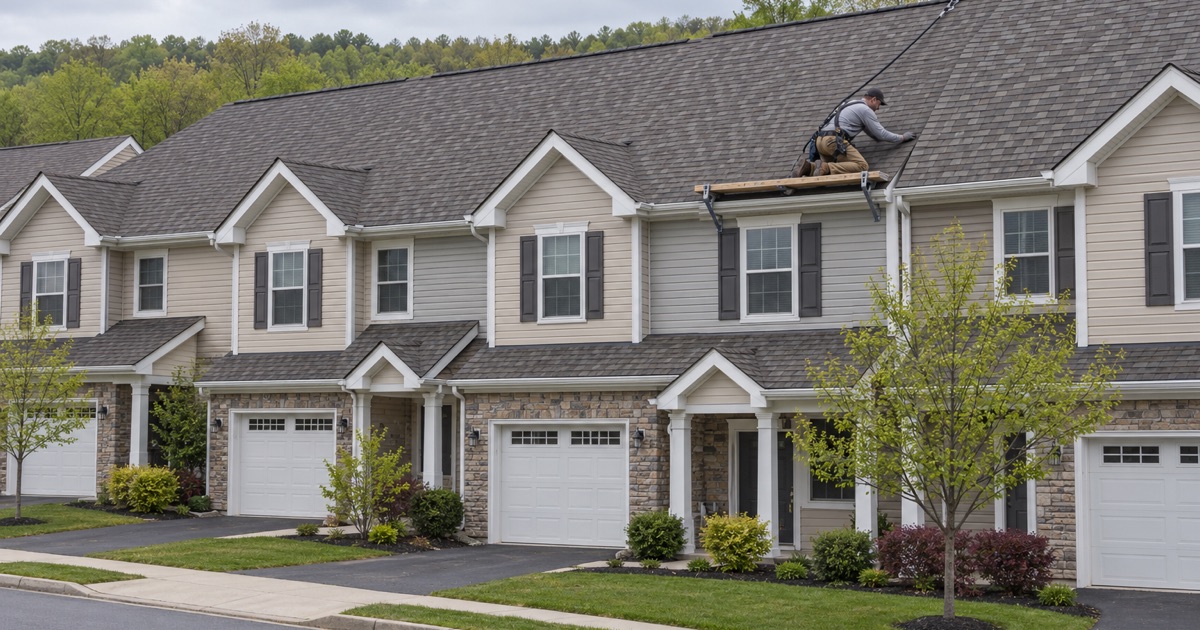
South Abington Township covers 9.1 square miles of Lackawanna County, with the Chinchilla census-designated place in its southern part and the northern end of the Pennsylvania Turnpike Northeast Extension within its borders. Most homes here are detached, yet a meaningful share are attached units. Those attached homes are where roof decisions stop being a simple matter between an owner and a contractor.
Attached Homes in a Mostly Detached Township
Census estimates for the township count 389 one-unit attached homes, about 10.9% of the housing stock, and 243 of those are owner-occupied. Slightly more than half of all homes here, 51.6%, were built between 1980 and 2009. That puts many roofs from those decades on the list of buildings where owners and associations are thinking about replacement budgets.
With a median home value of $334,700 reported for the township, a roof is a large line item protecting a large asset. On a townhouse, though, the roof also belongs visually to the whole building. One unit’s shingles sit beside the neighbor’s, so a replacement choice made for one home is seen by everyone who looks at the row.
The Association Contracts End-of-Life Roofing
South Abington Woods Phase II is a private townhouse community capped at 100 units under its recorded documents. Its Amended and Restated Declaration, made December 7, 2023, describes it as a planned community in South Abington Township. Article IV of that declaration lists roofing and siding at the end of its natural life cycle among the long-term maintenance items the association can assess for.
The declaration is direct about who hires that work: it is the responsibility of the Association, and not the Owners, to contract long-term maintenance services. For an owner in that community, a worn-out roof is a matter to raise with the property owners association rather than a project to bid out alone. If an owner there reaches us about an aging roof, that is the first thing we point out.
How a Unit-Specific Special Assessment Works
The same article lets the association levy a special assessment to pay for that long-term work. The assessment is unit-specific, based on the condition of the unit and the quantity of work required for it. Two neighbors on one row may therefore see different figures, because one roof may need far more decking or flashing work than the roof beside it.
That structure rewards a clear, itemized scope. A written estimate that separates tear-off, decking, underlayment, flashing, ventilation and gutters shows where each unit’s number comes from. When a board compares proposals, line-by-line scopes let it see which unit needs what, instead of reading one lump sum that hides the difference between a sound roof and a tired one.
Looking for roofing closer to Clarks Summit? See Roofing Services in Clarks Summit.
Same Color, Same Materials: Matching a Townhouse Row
Article IV of the South Abington Woods Phase II declaration sets the standard every roof job there must meet. All work must be consistent with the original construction and conform to the same color, materials, and appearance of the development. That single sentence shapes product choice, ordering and installation details long before the first bundle is carried up a ladder.
Reading the Existing Roof Before Choosing a Product
Matching starts with identifying what is on the roof now. Architectural laminated shingles from different product lines, such as GAF Timberline HDZ, Owens Corning Duration or CertainTeed Landmark, can look similar from the driveway and different up close. We note the shingle profile, the color blend, the exposure and the ridge treatment so the replacement reads as part of the same building.
Weathering complicates the match on any row where units were reroofed at different times. A new roof beside a faded one will look newer for a while, which is why the original color and material, not the faded surface, is the target. Where an exact product has been discontinued, that question belongs to the association before any order is placed.
Details That Have to Line Up Across Units
Townhouse roofs share ridges, valleys and wall lines with the units on either side. Drip edge at eaves and rakes, ridge vent lines and the reveal of each course need to meet the neighboring roof cleanly. A seam where two roofs join is where a mismatch shows first and where water finds its way inside when the transition is rushed.
Party-wall transitions also carry step flashing and counter flashing, often at changes in roof height between units. We replace that flashing with the roof rather than reusing old metal under new shingles. Kick-out flashing at the bottom of a wall line keeps water from running behind siding, which matters on a building where siding is also an association item.
Gutters, Ventilation and Cleanup on a Shared Row
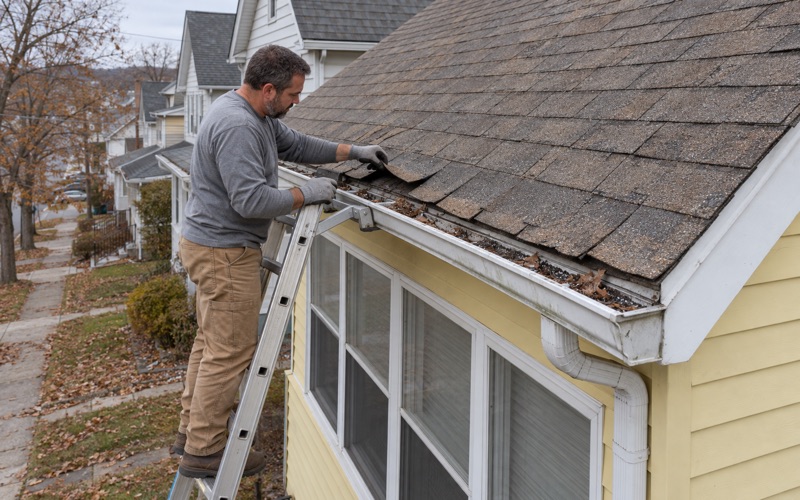
Gutters on a row of townhouses carry water from several roofs toward a limited number of downspouts. We size and pitch seamless aluminum gutters and downspouts with the roof, matching their color to the rest of the building. Ventilation gets the same attention, balancing ridge vent exhaust with soffit intake so attics on adjoining units are not left trapping heat and moisture.
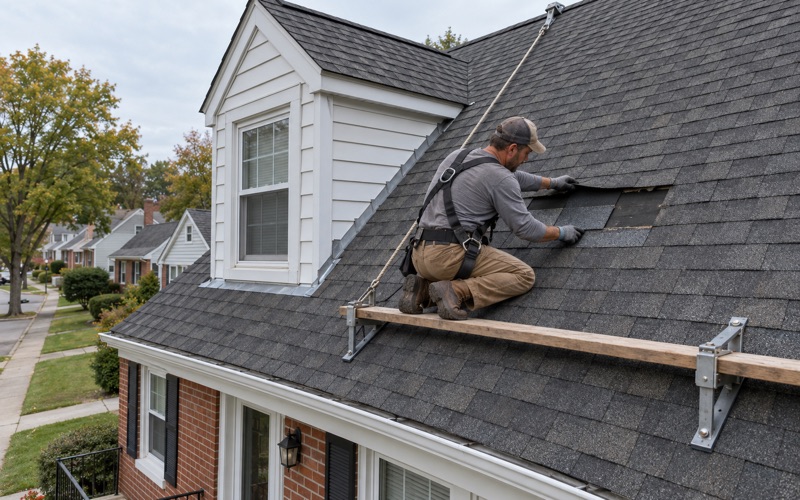
Working on a row also means working beside occupied homes. Driveways, walks and yards next to the job are cleaned at the end of each day, including a magnet sweep for roofing nails. On a townhouse site a neighbor’s driveway is often a few steps from the drop zone, so cleanup covers more than the unit being worked on.
Storm Damage Versus End-of-Life Replacement
The South Abington Woods Phase II declaration treats a worn-out roof and a storm-damaged roof as two different events. End-of-life replacement runs through the association and its special assessment. Damage from a catastrophic event, an act of God in the declaration’s words, falls to the owner, who carries the insurance meant to pay for rebuilding.
The Owner’s Own Homeowner Policy
Article V requires each owner to carry a Homeowner policy, not a condominium policy, with hazard coverage sufficient to rebuild the unit. The property owners association must be named as an additional insured. So when a storm damages a roof there, the claim runs through the owner’s own carrier, and Article VI makes the owner responsible for repair and reconstruction after a catastrophic event.
Article VI also says that repair must return the unit to the same color, materials, and appearance. A storm repair is therefore held to the same matching standard as a planned replacement, even though the owner, not the association, is paying for it through the claim. The adjuster reviewing that claim needs to see the standard reflected in the repair estimate.
Documenting Damage and the Thirty-Day Clock
Article V asks owners to begin repairs within thirty calendar days after an insured loss, if reasonably feasible. That window makes prompt documentation worth the effort. We photograph storm damage and write it up for the owner’s own claim, and every leak call includes a look in the attic so the water is traced to where it actually enters.
When an owner asks, our crew will meet the insurance adjuster on site and walk the damage together. We do not negotiate the claim; in Pennsylvania that role belongs to the owner or to a public adjuster licensed under state law. Our part is to show what is damaged, what it takes to fix it and how the repair matches the row.
When the Association Can Step In
Article VI states that no unit shall be permitted to fall into disrepair. If an owner does not complete repairs after a catastrophic event, the association may complete them and place a lien on the unit. A storm-damaged roof left untouched is therefore more than a leak risk inside the home; it can become a cost the owner pays anyway.
Whether a damaged roof can be repaired or needs a larger section replaced is the first question we answer. A straight answer on repair comes before any talk of replacement, and on a townhouse that answer also has to respect the neighbor’s roof. A sound, matching repair keeps the unit within the declaration without reaching for more work than the storm caused.
Permits and Inspections in South Abington Township
Every municipality in our service area sets its own re-roof permit rule, so we check the rule for the home’s own municipality before pricing a job. In South Abington Township that check starts with the township’s published form and the building code official who reviews it. Owners in South Abington Woods Phase II also have an internal step with their community.
The Roofing Line on the Township Permit Form
South Abington Township publishes a Building and Electrical Permit application on its forms page, to be completed and sent in. Among the types of work it lists is a line for roofing with total square feet, alongside fencing, signs, pools, decks, demolition and accessibility. The form also carries a UCC building fee line reserved for the building code official.
The form itself does not say when a roofing permit is required, and we do not assume an answer either way. Before pricing, we confirm with township administration, reachable at (570) 586-2111, whether the planned scope calls for that roofing line. The answer goes into the estimate so permit cost and timing are visible from the start.
Building Inspection Underwriters and the UCC
South Abington Township opted in to the Pennsylvania Uniform Construction Code with no amendments, effective June 30, 2004. The state labor department’s municipal list names a building code official for the township at the number used by Building Inspection Underwriters of Pennsylvania, based in Scranton. Where a permit applies, plan review and inspection run through that code administration.
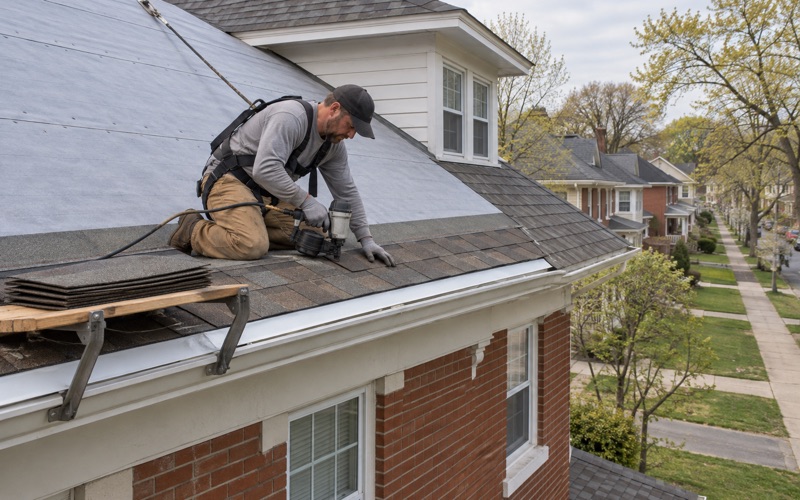
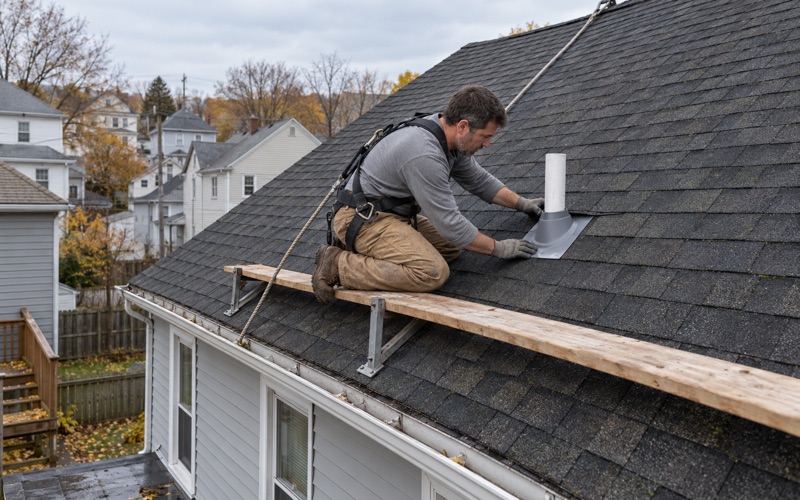
Under the 2021 International Residential Code as adopted in Pennsylvania, reroofing rules limit how many layers can stay on a roof, and eaves call for an ice barrier where conditions require one. We size self-adhering ice and water barrier to the overhang of each unit. Synthetic underlayment, drip edge and new pipe boots round out the layers beneath the shingles.
External Modification Permits and the Contract
The community directs owners to Preferred Management Associates, at 570-842-2705, for an External Modification Permit as well as for resale certificates. Because the association contracts end-of-life roofing, that office is a sensible first contact for any owner wondering where a roof stands in the community’s plans. It is also where questions about matching products are best settled.
Whoever signs a roofing contract here, the paperwork follows Pennsylvania’s Home Improvement Consumer Protection Act. That means a three-business-day cancellation notice and a deposit kept within the one-third limit on contracts over $5,000. If damaged decking turns up after tear-off, it is photographed and shown before replacement, at a per-sheet price already written into the contract.
- 20+ Years Roofing
- Free Written Estimates
- Repair Before Replace