
Scranton Quality Roofing handles roof leak repair in Scranton, PA, serving surrounding cities including Dunmore, Moosic, Old Forge, Throop and Dickson City. For more than 20 years we have tracked down leaks in older Lackawanna Valley houses, from slate roofs over prewar homes to flat roofs on rear additions, and fixed them at the source.
The place water drips onto your ceiling is rarely where it enters the roof. Water can run along a rafter, the top of a ceiling joist or the underside of the decking for several feet before it finds a way down. That is why every leak call we take includes time in the attic as well as on the roof, so we trace the water to the spot where it actually gets in before we price the repair.
Once we find the source, we replace the part that failed instead of covering it with roof cement. And if the leak turns out to be plumbing, a vent fan or condensation, we tell you that too, so you are not paying for roof work that will not stop the water.
Finding the Source of a Roof Leak
Tracing Water From the Ceiling Into the Attic
We start below the stain and work upward. In the attic we look for darkened sheathing, water trails on rafters, wet insulation and rusty nail tips, then follow the trail uphill to its highest point. That point is usually within a few feet of where the water passes through the roof.
A flashlight, a moisture meter and photos from both sides of the decking let us show you the path. When the attic is finished or inaccessible, we rely more on the roof surface and the timing of the leak.
Roof Leak, Plumbing Leak or Condensation?
Not every wet ceiling is a roof problem. A leak that shows up on dry days usually means plumbing, an air conditioning condensate line or a bathroom fan blowing moist air into the attic. Frost that forms on the underside of the decking in cold weather and melts on a sunny day can drip like a leak.
We check the timing, the location and the attic conditions before recommending any roof work. If the cause is ventilation or a fan duct, we explain what needs to change so the problem does not come back.
Reading the Weather Pattern
When a leak appears tells us a lot. Leaks only during wind-driven rain often come from flashing or siding joints on the windward side. Leaks during snowmelt point to ice dams at the eaves. Leaks in every rain usually mean a failed pipe boot, open seam or missing shingle.
We ask you about the timing before we climb the ladder, because it narrows down where we look first. A note of the date and the wind direction during the last leak is often the most useful clue we get.
Common Roof Leak Sources and Their Repairs
Chimney Flashing Leaks
Chimneys are the most common leak point on older houses. Step flashing rusts, counter flashing pulls out of the mortar joints and layers of tar crack. We rebuild the flashing with new step flashing woven into the shingles and counter flashing cut into a reglet in the brick.
Wide chimneys without a cricket catch water and debris on the uphill side. Adding a cricket, or saddle, splits the flow around the chimney and stops the water from pooling against the brick.
Pipe Boots and Roof Vents
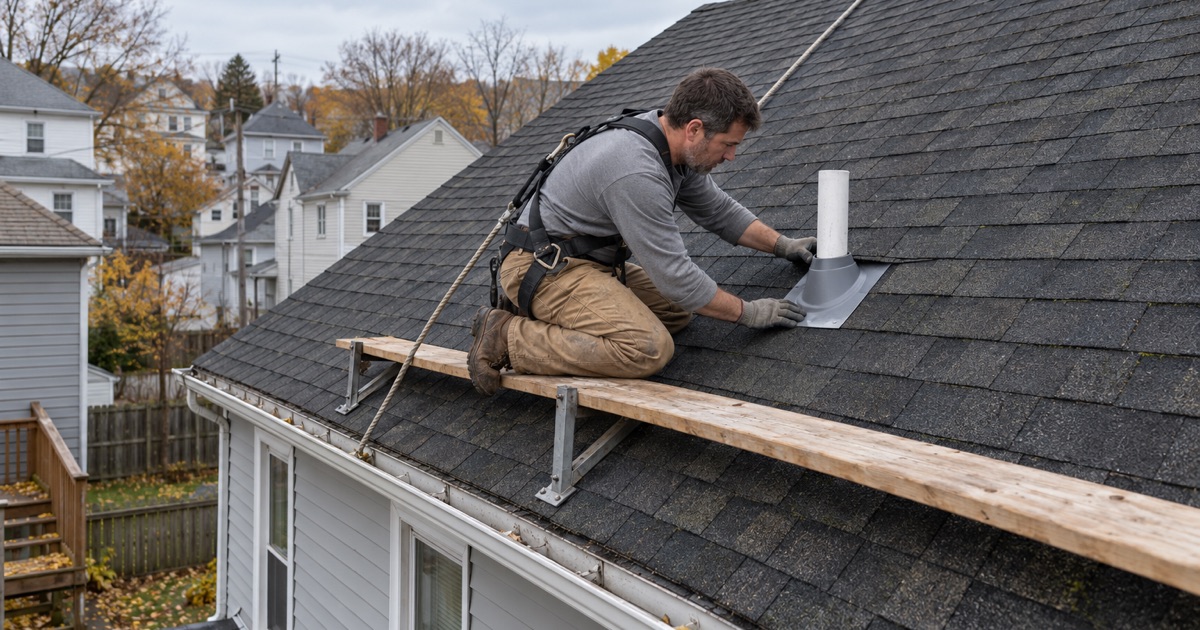
The rubber collar on a plumbing vent boot dries out and splits after years of sun. Water then runs straight down the pipe into the house. We replace failed boots with new rubber or lead flashing boots and reseat any roof vents whose flanges have lifted.
This is one of the simplest leak repairs we make, and one of the most common. Catching a cracked boot early keeps a small repair from turning into a stained ceiling and wet insulation.
Valleys and Roof-to-Wall Joints
Valleys carry more water than any other part of the roof, and a worn or poorly cut valley leaks under heavy rain. We repair or rebuild valleys with ice barrier underneath and properly cut shingles or metal lining.
Where a roof meets a sidewall or dormer, missing step flashing or a missing kick-out flashing sends water behind the siding. We install kick-out flashing to turn water into the gutter and replace step flashing along the wall.
Skylight Leaks
Skylight leaks usually come from the flashing around the curb rather than the glass. We re-flash curbs with step flashing on the sides, a head flashing at the top and an apron at the bottom. When the skylight unit itself has failed, we tell you and discuss replacing or removing it.
Condensation on the inside of a skylight can also run down the well and look like a roof leak. If the glass fogs on cold mornings and the flashing is dry, the fix is airflow and humidity in the room, not more roofing.
Seasonal Leaks in Northeastern Pennsylvania
Ice Dam Leaks Along the Eaves
Scranton averages about 45 inches of snow a year, and older homes with thin insulation and poor ventilation lose enough heat to melt snow on the upper roof. That water refreezes at the cold eaves, builds a ridge of ice and backs up under the shingles.
We stop the active leak, then look at the cause. Long-term fixes include a self-adhering ice barrier at the eaves, better attic insulation and balanced ventilation with soffit intake and a ridge vent.
Wind-Driven Rain and Blown-Off Shingles
Strong wind lifts shingles whose seal strips have aged, exposing nail lines and letting rain blow underneath. We replace missing shingles, reseal lifted tabs and inspect nearby flashing. If many shingles have let go, we discuss whether a higher wind-rated shingle makes sense.
After a windstorm, we photograph every damaged area and write it up for your own insurance claim. If you want us there, we will meet the adjuster on site to show what we found, while the claim itself stays between you and your insurer.
Gutter Backups and Fascia Leaks
Clogged or undersized gutters overflow behind the fascia and soak the roof edge. We clear the cause, add drip edge where it is missing and resize or rehang gutters so water flows to the downspouts. Rotted fascia and decking at the edge are replaced as part of the repair.
Flat Roof and Commercial Leak Repair
Leaks on Additions, Porches and Garages
Low-slope roofs leak at seams, at blisters and where water ponds. We repair modified bitumen, EPDM and TPO with compatible materials and pay close attention to the joint where the low roof meets the house wall, which is the most common leak point on rear additions.
Many of these small roofs were originally covered with shingles or roll roofing at a pitch too low for either. Patching them buys time, but when the same roof keeps leaking, we explain why a membrane rated for low-slope use is the lasting fix.
Commercial Roof Leaks
On commercial buildings we trace leaks to open seams, drains that have pulled away from the membrane and flashing around rooftop HVAC curbs. Water can travel far under a membrane before it appears inside, so we probe for wet insulation and map the affected area before repairing it.
When a leak is over inventory, equipment or occupied space, we set up a temporary fix first and plan the permanent repair around the business. The owner gets photos of the source and the repair for building records.
Our Step-by-Step Roof Leak Repair Process
Step 1: Stop the Water
If water is actively coming in, we start with a temporary cover to protect the interior while we diagnose the problem. Keep the receipt for your records.
Step 2: Trace the Leak
We follow the water from the stain through the attic to the roof and photograph each step. You see the evidence before you approve the repair.
Step 3: Repair the Failed Part
The failed flashing, boot, shingle or seam is replaced with proper materials, not sealant. Nearby flashing and shingles are checked while we are there.
Step 4: Check After the Next Storm
We ask you to check the attic after the next heavy rain, and we come back if anything changes. A dry attic after a hard storm is the real proof.
- 20+ Years Roofing
- Free Written Estimates
- Repair Before Replace