Scranton Quality Roofing has spent more than 20 years on roofing in Old Forge and across the Lackawanna Valley, and most of that work starts with one question from the owner: what is actually wrong with this roof? We answer it by looking at both sides of the deck. Every leak call includes time in the attic as well as on the shingles, so the water is followed back to where it really enters before a single line gets priced.
That habit matters more here than in most places. A stain on a bedroom ceiling can come from a cracked pipe boot, a lifted shingle, or flashing that has been pulled loose at a wall, and each of those calls for a different fix. We tell you plainly whether the roof can be repaired before anyone mentions replacement, and when replacement is the right answer, our written scope breaks tear-off, decking, underlayment, flashing, ventilation and gutters into separate lines you can compare against any other estimate.
This page covers what is particular to roofing in this borough. That means the abandoned mine workings beneath it, the state’s recent reclamation work, the insurance program built for that risk, and what a roofer can and cannot tell you when a ridge or chimney starts to move.
Abandoned Mines and the State’s Recent Work in Old Forge
Coal workings beneath the borough
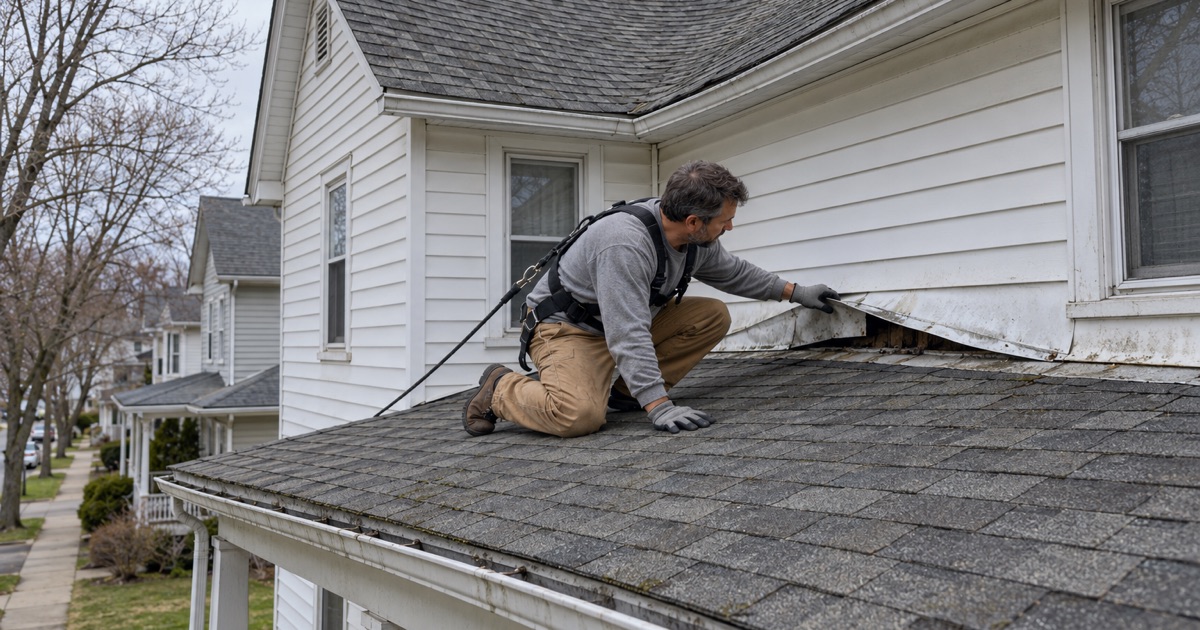
Old Forge is a borough of Lackawanna County, about five miles southwest of downtown Scranton, and like much of the valley it was built over coal. The mines that once ran beneath its streets were abandoned long ago, but the voids they left did not go anywhere. Ground over old workings can settle, and settlement under a house travels upward until it reaches the framing and the roof.
We do not treat that as a reason for alarm, and we do not claim to know what lies under any particular lot. What it means for our work is that a roof here gets read for movement as well as for weather. A shingle problem and a structural shift can leave similar marks on a ceiling, and the difference changes who you should be calling next.
Four DEP projects from 2021 and 2022
The Pennsylvania Department of Environmental Protection keeps a public record of its abandoned mine work. A Bureau of Abandoned Mine Reclamation project table prepared November 23, 2022 lists four completed Old Forge projects with subsidence in their titles. The earliest is Skula Subsidence 2, a maintenance project completed September 16, 2021, and the latest is the emergency Thompson & Krappa Subsidence project, completed May 4, 2022 on a site of about one acre.
Between those two sit Emer Ellis Subsidence, completed October 1, 2021, and Ellis Subsidence 2, completed May 2, 2022. The names are surnames carried in the project titles, not street names. Each project was small by state standards, with recorded costs running from $1,129 to $2,881, and the table codes all four as VO, which its legend defines as a vertical opening rather than its separate subsidence code.
What the record does and does not say
Those entries show that the state has been active inside the borough recently, which is worth knowing if you own a house here. They do not describe damage to any home, and we have not read any report of a house affected by those openings. We mention them because they are the plainest local evidence that the old mines remain a working concern for the agency responsible for them.
For a homeowner, the practical point is that ground movement is a recognized risk with its own state program and its own process. A roofer has a part in that process, and it is a narrow one. The next two sections lay out where that part begins and where it stops.
Looking for roofing closer to Throop? See Roofing in Throop.
Mine Subsidence Insurance for Old Forge Homeowners
What the program covers
The Department of Environmental Protection runs Mine Subsidence Insurance as a statewide program, and the borough does not administer it. In DEP’s own words, the coverage applies to losses from earth movement and ‘damage from the collapse of underground coal and clay mines in Pennsylvania.’ DEP also notes that damage from mine subsidence or mine water breakouts is ‘usually not covered by your homeowner’s insurance policy,’ which is the gap the program exists to fill.
That exclusion surprises a lot of owners. A standard policy may respond well to a wind-torn field of shingles and still decline a roof that cracked because the house below it shifted. Knowing which kind of damage you are looking at, and which policy is meant to answer for it, is the first decision after something goes wrong.
Cost and the inspection requirement
DEP lists residential coverage of $150,000 at $41.25 a year, which works out to roughly 27 cents for every $1,000 of coverage. Policies are available from $5,000 to $1,000,000, so an owner can match the amount to the house rather than to a fixed tier. DEP will require an inspection before a policy can be purchased.
Applications go through DEP online or by phone at the MSI Help Desk, 1-800-922-1678. We are not part of that inspection and do not arrange it. Owners who want coverage should start with the program directly, ideally before any problem appears rather than after one does.
Where a roofer fits
Our role, if you call us about a roof that looks wrong, is documentation. We photograph what we find, measure it, and write it up in plain language you can hand to whoever needs it. We will meet an adjuster on site when asked, but we do not negotiate a claim and we do not file one on your behalf.
Whether mine subsidence caused a given problem is DEP’s determination, not ours. We can tell you that a ridge has dropped or a chimney has separated from the deck. We cannot tell you why the ground did what it did, and any roofer who claims otherwise is guessing.
What Ground Movement Can Look Like on an Old Forge Roof
A sagging or kinked ridge
The ridge is the longest straight line on most roofs, which makes it the easiest place to see movement. A ridge that dips in the middle, kinks at one point, or no longer lines up from gable to gable is telling you something changed in the structure. Sometimes the cause is ordinary, such as rafters that were undersized or decking that has rotted under a long leak.
We check from the attic before we draw any conclusion. Rafters, collar ties and the ridge board itself show whether the sag comes from wood that failed or framing that moved as a unit. The first is a roofing and carpentry repair, while the second is a reason to document carefully and point you toward the people who assess ground movement.
A chimney pulling away
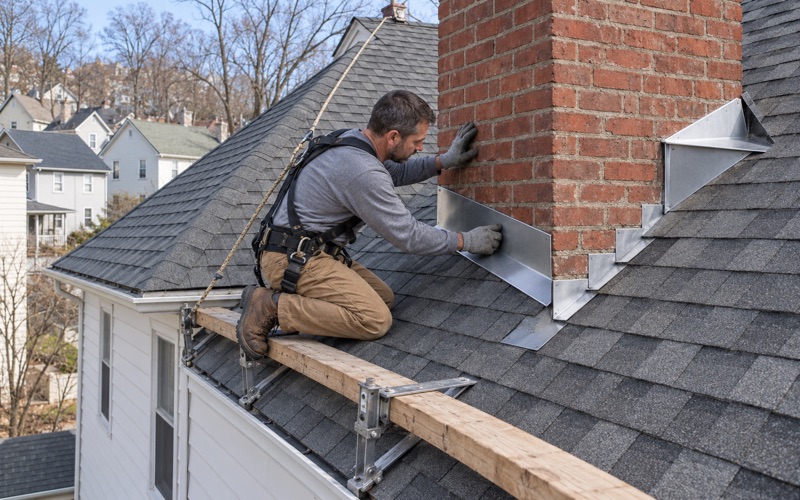
Masonry chimneys are heavy and sit on their own footing, so when a house settles they do not always move with it. The result is a gap that opens between the chimney and the roof deck, often first visible as step flashing that has torn or counter flashing that has pulled out of its joint. Water follows quickly once that seam is open.
When we replace a roof, step, counter and chimney flashing all come off and new metal goes on with it; we never reuse old pieces under new material. On a chimney that has shifted, though, new flashing alone is not a permanent answer, and we say so. We photograph the gap and the condition of the masonry so the record shows what was there before anything was covered.
Flashing torn at a wall line
Anywhere a roof meets a vertical wall, such as a dormer, a second-story addition or a porch roof tied to the house, the flashing is the hinge between two parts that can move separately. A tear there, or a line of nails backed out along it, can mean the wall and the roof plane have shifted relative to each other. It can also mean the flashing was simply installed badly.
Telling those apart takes a close look at the pattern. Weather wear tends to be general, while movement tends to concentrate in one place and leave a crisp edge. We record both kinds the same way, with photographs and measurements, and let the cause be settled by whoever has the authority to settle it.
Old Forge Houses, Mine Water and the Borough Office
The houses we work on here
The Census Bureau’s 2024 five-year estimates count 3,786 occupied homes in the borough, and 2,649 of them are owner-occupied. Of those owner-occupied homes, 2,447 are detached single-family houses, which makes the detached house the core of roofing work in this town. A large share is old: 1,110 housing units date from 1939 or earlier, and another 344 from the 1940s.
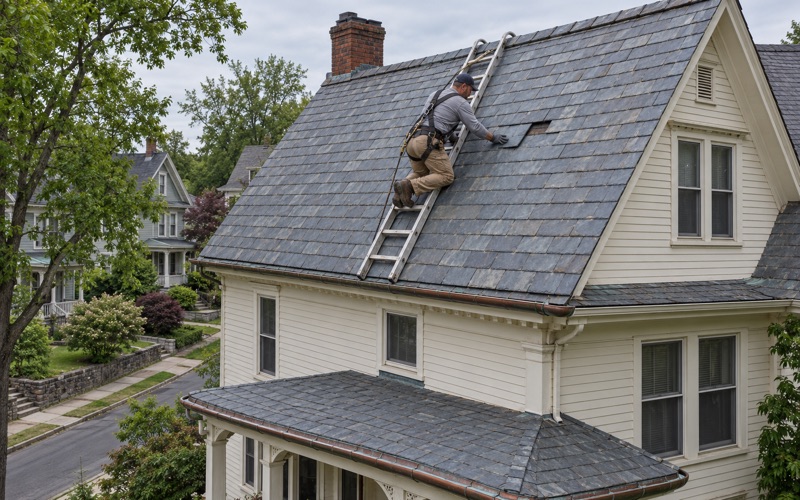
Houses of that age can carry more than one generation of roofing, and some still have slate. Where sound slate remains, we repair it slate by slate with copper nails and slate hooks before anyone discusses tearing it off. Where an older roof does come off, any damaged decking is photographed and shown to you before it is replaced, at a per-sheet price already written into the contract.
The borehole and the Keyser Valley
Mine water is the other half of the underground story. The Old Forge borehole, drilled by the Army Corps of Engineers in the early 1960s, sits in what one history source describes as the lowest area of the Keyser Valley. It is about 400 feet deep and drains an estimated 100 to 150 million gallons of abandoned mine water a day into the Lackawanna River.
The same source says that without it, water would seep into the basements of low-lying houses and businesses along a stretch of the valley. That is a basement concern more than a roof concern, but it helps explain why DEP’s program names mine water breakouts alongside subsidence. For a roof, what matters is that the ground under the borough has a long, managed relationship with the mines beneath it.
Checking the borough’s own rule
Every municipality around here sets its own re-roof permit rule, so we confirm the rule for the house’s own borough before we price the job. Old Forge’s Zoning and Code Enforcement page lists a Zoning Officer and Code Enforcement Officer and a deputy, reachable through the borough building at 310 South Main Street. It does not publish a permit list for roofing.
Because nothing is posted, we ask the office directly rather than assume. The answer goes into the written scope, along with a self-adhering ice barrier sized to the overhang at every eave, since valley winters push ice dams up under the first courses of older roofs. At the end of each work day the driveway, yard and gutters are cleaned, including a magnet sweep for stray roofing nails.
- 20+ Years Roofing
- Free Written Estimates
- Repair Before Replace