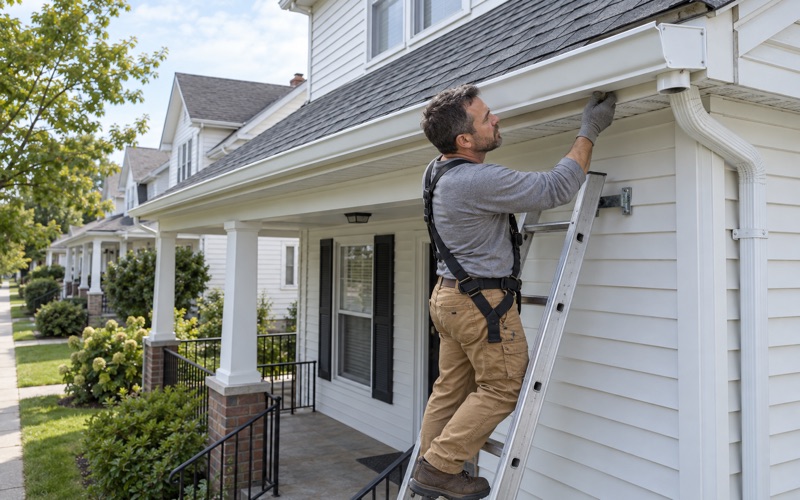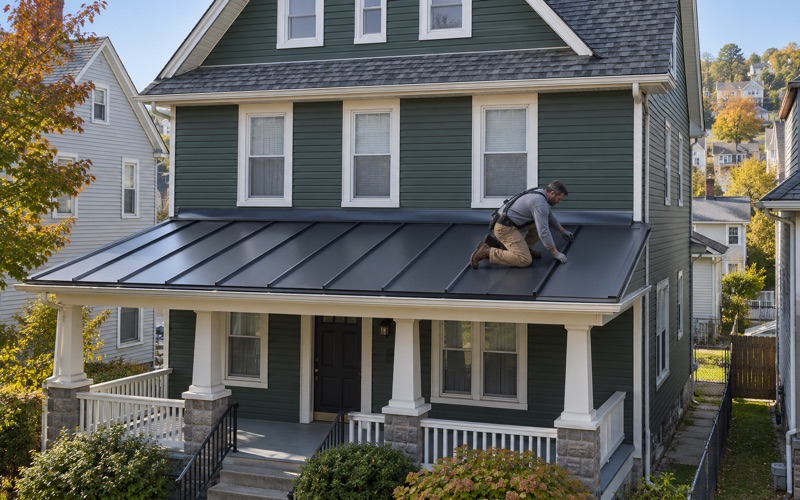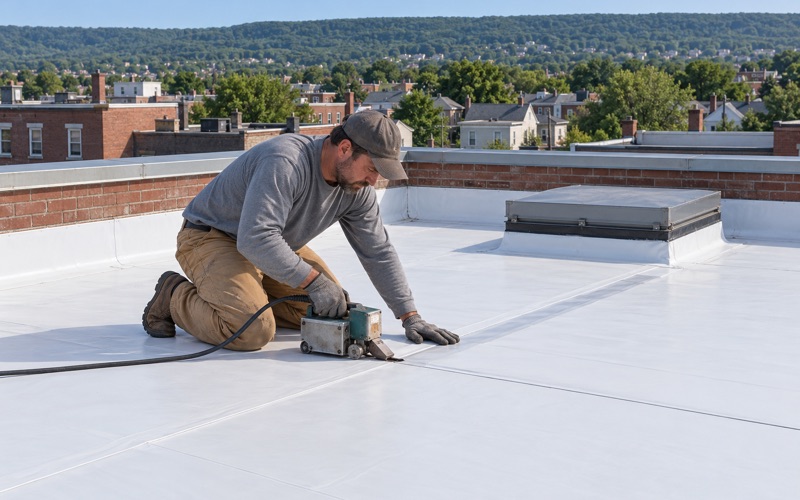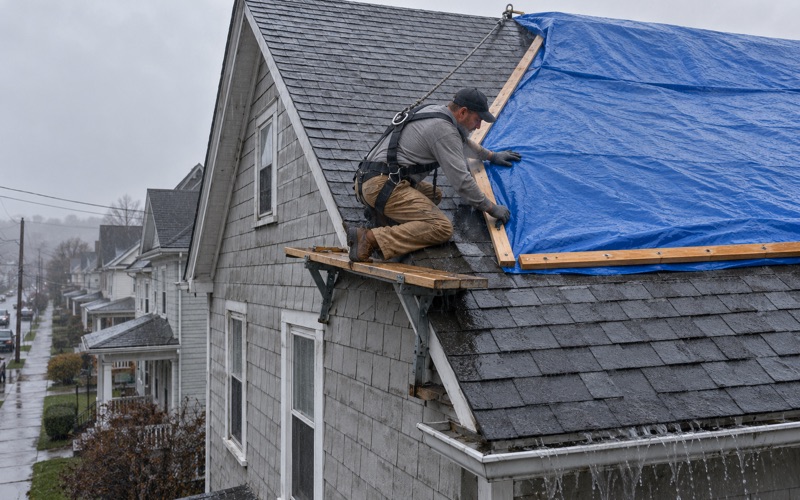
Scranton Quality Roofing has spent more than 20 years on roofing in Nanticoke and the rest of Northeastern Pennsylvania, and a surprising share of the work here begins with one question: whose roof is it? On a house that shares its roof line with the place next door, the honest answer is often two owners. We plan the job around both of them from the first visit instead of discovering the problem on the ladder.
Before replacement ever comes up, we tell you plainly whether the roof can be repaired. Every leak call includes a look in the attic as well as on the shingles, so the water is traced to the spot where it actually gets in. On an attached home, that spot can sit on the far side of the seam, which changes what needs fixing and who should pay for it.
Our written scopes break tear-off, decking, underlayment, flashing, ventilation and gutters into separate lines. You can lay our estimate beside anyone else’s and compare it item by item, and you can see exactly where the work on your half of the roof stops.
Re-Roofing One Half of a Nanticoke Double
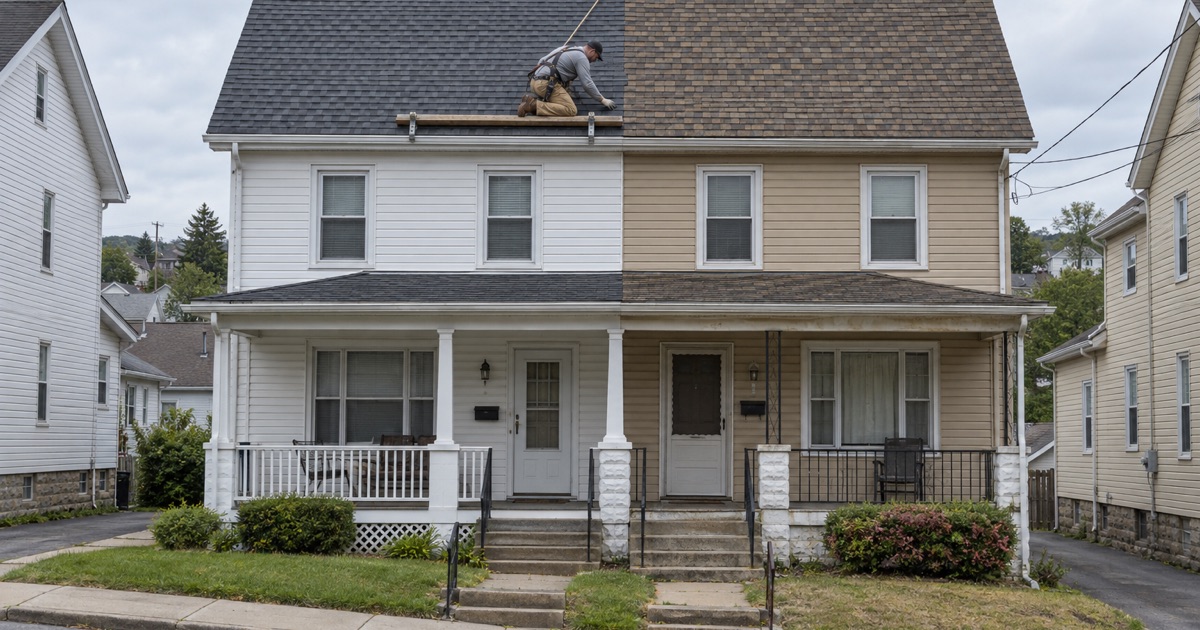
In the ACS 2024 five-year estimates, 957 of Nanticoke’s 5,076 housing units are single-family attached homes, nearly one in five. That Census category also counts rowhouses and townhouses, not only side-by-side doubles. Still, the double is a familiar shape in the city: two homes under one long roof, divided down the middle by a party wall.
Where your roof ends and the neighbor’s begins
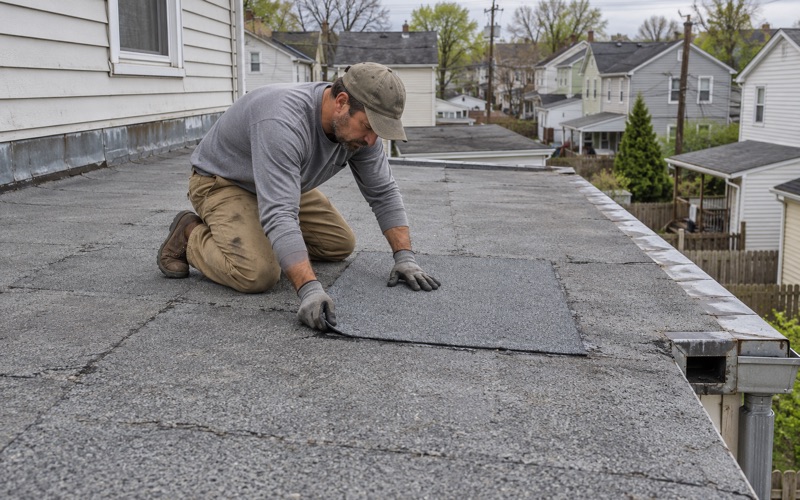
The roof rarely follows the property line neatly. Shingle courses run straight across the party line, the ridge is continuous, and one gutter may carry water from both halves. When only one owner re-roofs, the new material has to stop at a clean line and tie into old shingles that will stay in place for years.
We mark that line with you before tear-off and photograph the neighbor’s side as it stands. If the old material on the other half is already failing at the seam, we say so before work starts. A new roof tied into a rotten edge will leak at the joint no matter how well the new half was installed.
Flashing the party-line seam
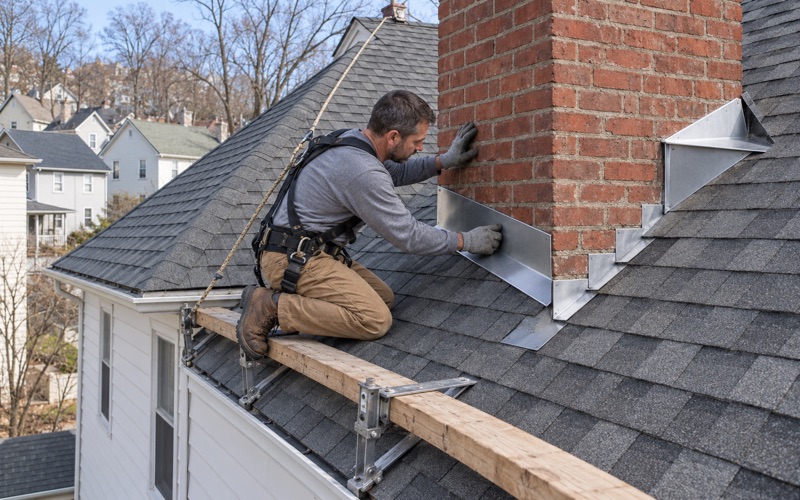
The seam is where most shared-roof leaks begin. Where the two halves meet at different heights or in different materials, we build the transition with metal flashing over a self-adhering ice and water barrier rated to ASTM D1970, lapped under both sides so water cannot track sideways into the wall. Where the planes are flush, we weave the new courses into the old as tightly as the old shingles allow.
Step, counter and chimney flashing that touches the seam is replaced with the roof, never reused. Old flashing bent back into place under new shingles is a common source of the next leak. On a double, that leak can show up in the neighbor’s attic as easily as in yours.
Drainage onto the other side
Water does not respect a party line. If your half drains into a shared valley or a gutter that runs onto the next eave, a new roof can change how much water reaches the other side and how fast it arrives. We size and pitch gutters and downspouts along with the roof, so runoff from your half lands where you expect it rather than against the wall next door.
Looking for roofing closer to Butler Township? See Roofing Services in Butler Township.
When the Other Half Is a Rental
Renters occupy 433 of Nanticoke’s attached single-family homes, and owners occupy 326, according to the same ACS estimates. Across the whole city, renters live in 1,964 of 4,415 occupied homes, about 44.5%. On a double, the person living on the other side of your roof is often not the person who owns it.
Reach the landlord, not just the tenant
A tenant can tell you the ceiling over the stairs has been stained for a year, which is useful. A tenant cannot approve work on the roof, though, or agree to share the cost of sealing the seam. Before the job is scheduled, we suggest contacting the landlord directly and in writing.
No city rule that we know of requires this conversation; it is practical advice. It does prevent the most common argument we see on shared roofs, which is a neighbor finding out about the seam after the dumpster arrives.
What to settle before the crew arrives
The useful conversation covers three points: where the new roof will stop, how the seam will be sealed, and whether the other half is close to needing its own replacement. If both owners are ready, doing the whole roof at once removes the seam entirely. If only one is, the landlord at least knows what the transition will look like.
When two owners do decide to replace the full roof together, we can write the scope so each half is priced on its own lines. That keeps the decking, flashing and gutter costs on each side visible, rather than buried in one combined number.
Notice, cleanup and contracts
Tear-off is loud and dusty, and a tenant working nights deserves warning, so we share the schedule with both sides. At the end of each work day we clean the driveway, yard and gutters and run a magnet sweep for roofing nails wherever debris could fall.
Our contracts follow Pennsylvania’s Home Improvement Consumer Protection Act. That means the three-business-day right of rescission is spelled out, and deposits on jobs over $5,000 stay within the one-third cap set by 73 P.S. 517.9.
Pre-1940 Framing Under the Shingles
Nanticoke’s housing is old: 2,188 of its 5,076 units, or 43.1%, were built in 1939 or earlier. The city peaked at more than 27,000 people in the 1930s as an anthracite mining town, and its named sections include Honey Pot, the Hanover Section and Downtown. Newport Creek flows through the city past the mountain known as Honey Pot before turning north toward the Susquehanna.
What we find under an old roof
Roofs from that era were usually framed with rafters and board sheathing rather than plywood, and many have been covered over more than once. Under IRC R908, part of the 2021 International Residential Code as adopted in Pennsylvania, a roof cannot take a new layer once it already carries two. A house in that condition needs a full tear-off down to the boards.
On a double, a full tear-off of one half also exposes the edge of the neighbor’s layers at the party line. We plan how to close that edge before the old roof comes off, not after a rainstorm finds it.
Decking you see before we replace it
Once the old roof is off, we photograph any damaged boards or soft decking and show them to you before anything is replaced. The per-sheet price is written into the contract ahead of time. A rotten stretch on an old roof does not turn into an open-ended bill.
Slate and ice at the eaves
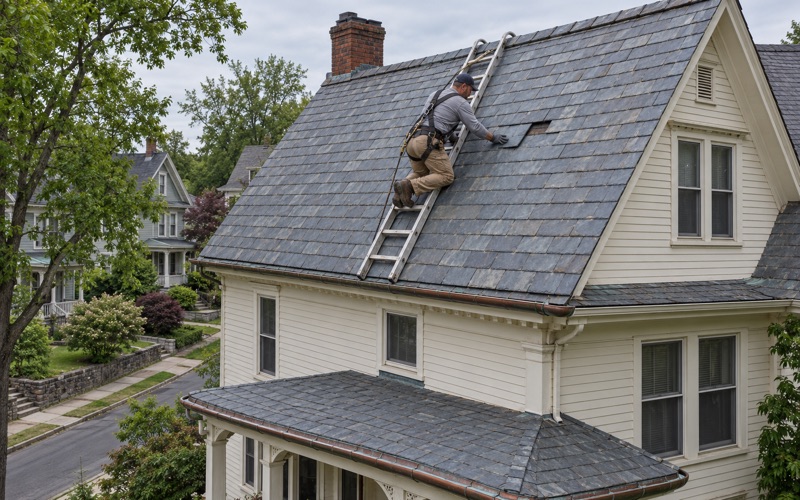
Where an original slate roof is still sound, we repair it slate by slate with copper nails and slate hooks before anyone suggests tearing it off. Sound slate on one half of a double also gives the other owner more reason to keep the roof line consistent.
Winters here build ice dams along the eaves of older homes, and Nanticoke sits in the National Weather Service’s Luzerne forecast zone, PAZ047. We size the self-adhering ice barrier to the house’s actual overhang, as IRC R905.1.2 requires, and on a double we run it right to the party line so no strip of eave is left uncovered.
Nanticoke Building Permits and Who to Call
Nanticoke is a third-class city in Luzerne County, and it enforces the Pennsylvania Uniform Construction Code itself, having opted in on April 9, 2004.
Jonathan A. Lang is listed as the building code official, reached through City Hall at 15 E. Ridge St., (570) 735-2800. Building permits are handled at City Hall at extension 104.
What the permit form asks
The city’s Building Permit Application lists types of work such as new building, alteration, addition and demolition, but it has no roofing checkbox. The city has not published a stance of its own on re-roofing. The form does ask for the contractor’s HIC number, issued through Home Improvement Consumer Protection Act registration with the Attorney General, and it carries a flood plain question citing Act 166-1978.
Each city, borough and township in our service area sets its own re-roof permit rule. Some repair work can fall under the UCC repair exemption in 34 Pa. Code 403.1(b)(9), but we check with Nanticoke directly before pricing the job rather than borrowing an answer from the next municipality over.
Code enforcement and neglected roofs
The city’s Code Officer cites neglected properties and files complaints with the magistrate. On a double, a failing roof is never only one owner’s concern, because water that gets through one half can travel along the shared wall. Fixing the seam early is cheaper for both sides than waiting for a citation or a ceiling to come down.
Storm damage on a shared roof
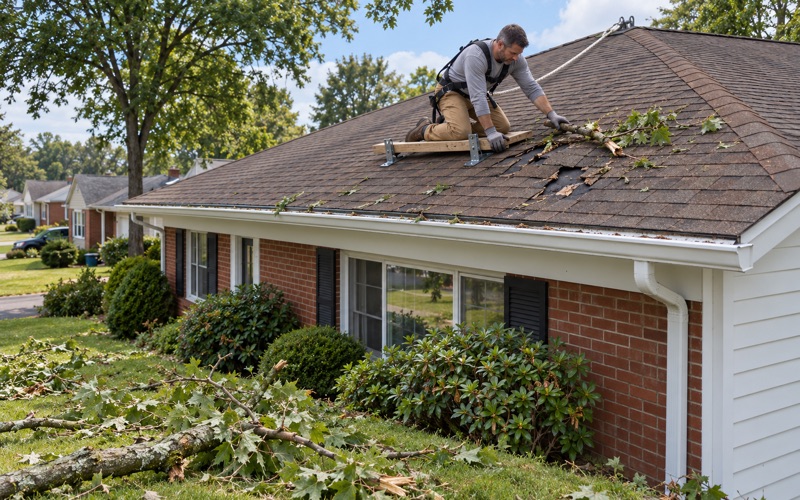
After a storm, we photograph the damage and write it up for your own insurance claim, and we will meet the adjuster on site if you ask. We do not negotiate the claim itself; in Pennsylvania that is work for a public adjuster under 63 P.S. 1601. When both halves of a double are hit, our write-up marks which damage sits on which side of the party line, so each owner can file with their own insurer.
- 20+ Years Roofing
- Free Written Estimates
- Repair Before Replace