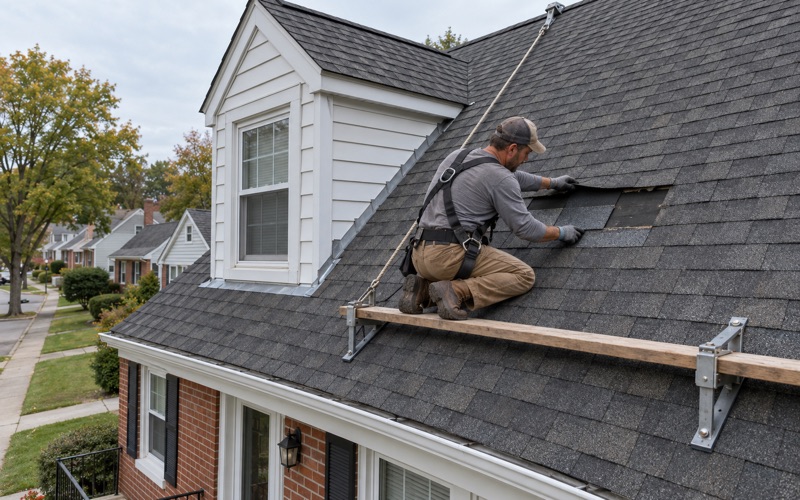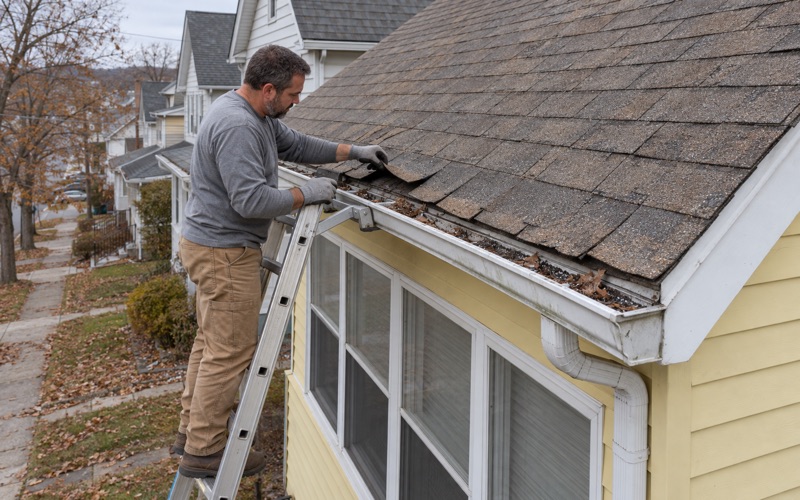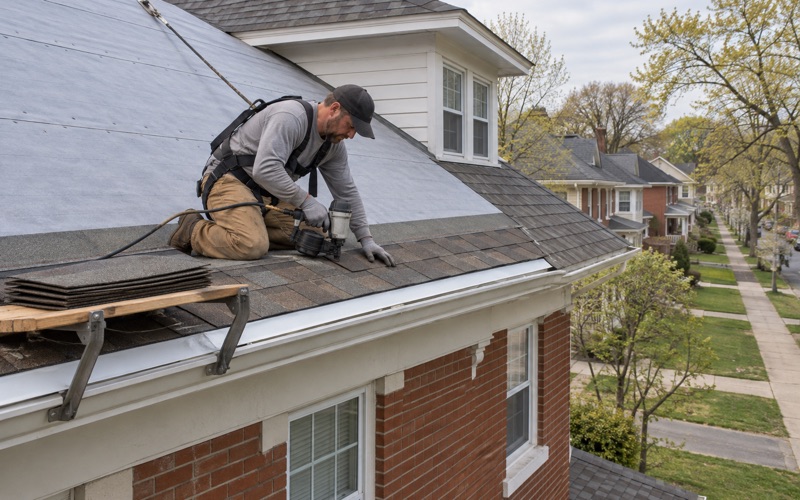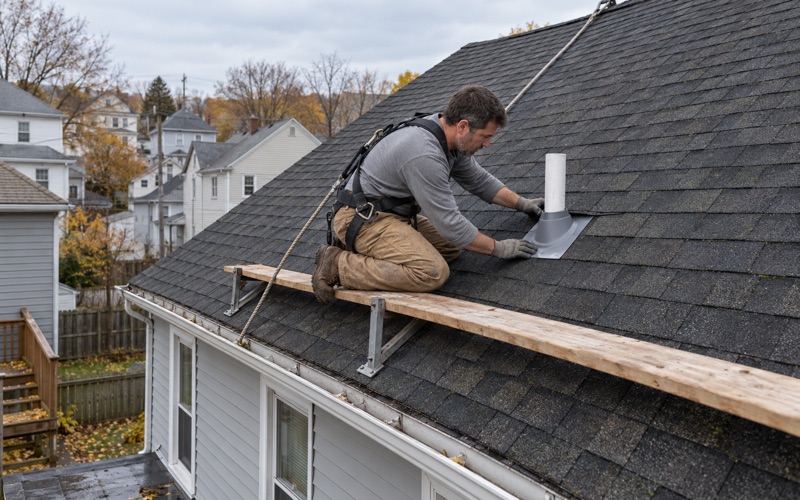
Scranton Quality Roofing has handled roofing in Moosic for more than 20 years, and a growing share of the calls we take here involve houses that are younger than most people expect. We inspect, repair and replace shingle, metal and low-slope roofs on detached houses, townhouses and larger custom homes throughout the borough. The work ranges from a single cracked pipe boot to a full tear-off down to the decking.
A leak visit here always includes two looks, one across the roof surface and one from inside the attic, so the water is followed back to where it actually enters before anything gets a price. If the roof can be fixed, we tell you that first and leave replacement out of the conversation. When it cannot, our written scope separates tear-off, decking, underlayment, flashing, ventilation and gutters into their own lines.
Those separate lines let you hold our number next to anyone else’s and compare the same item on both. Permit handling also differs from one municipality to the next around Scranton, so we confirm the borough’s process for your address before we quote rather than after the contract is signed.
Moosic’s 2000s and 2010s Houses Reach Their First Re-Roof
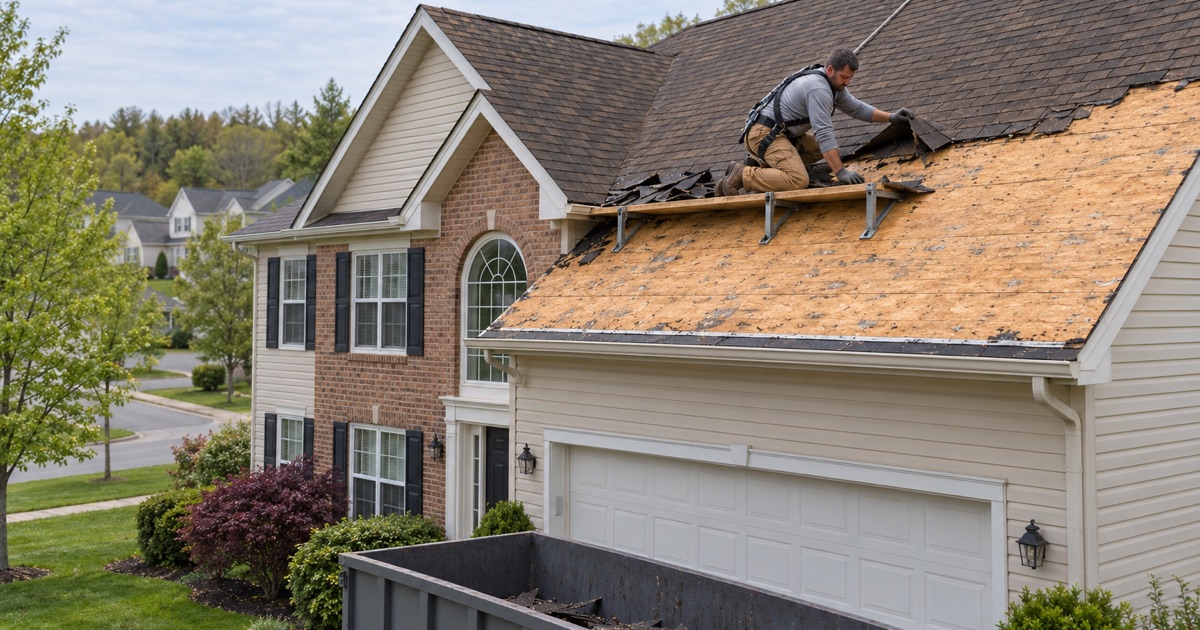
Moosic is a former coal-mining borough on the Lackawanna River, and its oldest streets still carry the houses that history left behind. What surprises people is how much newer housing sits alongside that core. The roofs on those newer homes are now the ones we are asked about most.
How much of the borough was built since 2000
The Census Bureau’s 2024 American Community Survey counts 978 of Moosic’s 2,705 housing units as built in 2000 or later, about 36.2% of the total. That breaks down to 446 homes from the 2000s, 463 homes from the 2010s and 69 completed since 2020. By contrast, the survey finds only 22 homes from the 1980s, so the borough’s building record skipped a generation before picking up again.
The older side is still large, with 624 units dating to 1939 or earlier and several hundred more from the postwar decades. That means two very different roof jobs share the same streets. A house from 1925 and a house from 2006 need different questions asked before anyone writes a scope, and we treat them that way.
Why roofs from the 2000s are coming due now
Many homes built during that decade went up with standard-grade asphalt shingles, and twenty-odd years of Lackawanna Valley weather is about where those start to show their age. We look for granule loss collecting in the gutters, curled or lifted tabs, exposed nail heads and pipe boots whose rubber collars have split. Attic signs matter as much: damp sheathing, frosted nail tips in winter and stained insulation around penetrations.
None of those signs automatically means replacement. A roof with sound shingles and one failed boot needs a boot, and we say so. A roof showing wear across every slope is a different conversation, and we explain what we saw on each face before recommending anything.
What a first tear-off on a newer home involves
Most of these houses still carry their original single layer, which keeps the tear-off simple and leaves the decking open for inspection. Any damaged sheathing we find is photographed and shown to you before it is replaced, at the per-sheet price written into the contract. Eaves get a self-adhering ice barrier sized to the actual overhang, along with drip edge at eaves and rakes, new step and counter flashing, and a ridge vent balanced against soffit intake.
Looking for roofing closer to Old Forge? See Old Forge Roofing.
Townhouses and Attached Homes in Moosic
The same survey counts 477 single-family attached units in Moosic, roughly 17.6% of the housing stock. About 264 of those are owner-occupied and 133 are rented. Roofing an attached home is its own kind of job, because the roof you own meets a roof you do not.
Working where two roofs meet
On a townhouse, the joint at the shared wall is where most trouble starts. Flashing at a party wall, a step in the roof line or a shared chimney has to be tied into the neighbor’s roof without tearing into it. We plan that seam before work begins, so the new material laps correctly and water sheds across the line instead of into it.
Attic access on attached homes is often a small hatch in a closet, and ventilation can be limited by the shared wall. We check whether the attic actually breathes, because a new roof over a starved attic ages faster than it should. If intake or exhaust needs to change, that appears as its own line on the scope.
Coordinating with the owner next door
When only one unit in a row is being re-roofed, the neighbor’s shingles, gutters and siding are right beside the work zone. We talk through staging and protection before the crew arrives, and we keep debris off the adjoining roof and yard. At the end of each day the driveway, lawn and gutters are cleaned, and a magnet sweep picks up stray roofing nails on both sides of the property line.
Gutters on attached rows
Runoff from a long attached roof often collects at one end, so gutter size and pitch matter more than they appear to. We size and pitch seamless aluminum gutters and downspouts with the roof itself, and we add kick-out flashing wherever a roof edge dies into a sidewall.
Glenmaura and Moosic’s Larger Custom Homes
Wikipedia describes the Glenmaura complex of upscale houses within the borough, set near Glenmaura National Golf Club. Homes of that size and style tend to have far more roof than a typical house on the same footprint. They also tend to carry the details that leak first when they are installed poorly.
Complex roof shapes and their weak points
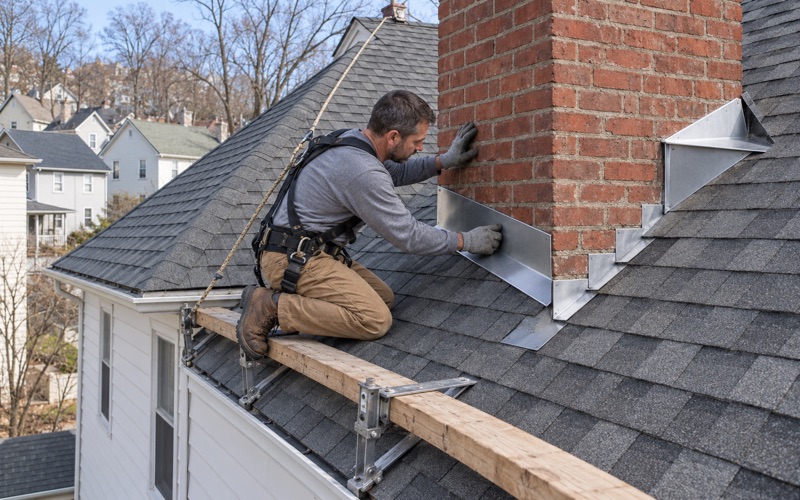
Larger custom homes usually combine multiple ridges, intersecting valleys, dormers, turrets and tall chimneys. Every one of those intersections is a place where water changes direction, and every one depends on flashing done properly. We replace step, counter and chimney flashing with the roof rather than bending old metal back into place, and we add a chimney cricket wherever a wide chimney faces uphill.
Open and closed valleys each have their place, and we match the valley method to the shingle and the pitch. Where a roof plane meets a stucco or stone wall, counter flashing set into a reglet gives a cleaner, more durable seal than surface-mounted metal and caulk.
Material choices for a higher-value home
The ACS puts Moosic’s median home value at $250,900, and the larger houses run well above that figure. Owners of those homes often ask about heavier architectural shingles such as GAF Timberline HDZ, Owens Corning Duration or CertainTeed Landmark, or about standing seam metal for a porch roof or a full main roof.
We walk through wind ratings like ASTM D7158 Class H, impact ratings like UL 2218 Class 4 and how each product’s look suits the house. Because each option is priced on its own line, you can see exactly what an upgrade costs before committing to it.
Storm damage on large roofs
After a wind or hail event, we photograph the damage across every slope and write it up so you have documentation for your own claim. If you ask, we will meet the insurance adjuster on site to point out what we found, but we do not negotiate the claim for you.
Roofing on Moosic’s Building Subcode Application
Moosic opted into the state construction code on 6/15/2004 with local amendments, and the borough’s Zoning Office lists Northeast Inspection Consultants, known as NEIC, as its third-party inspection agency at (570) 280-2111. The borough’s Building Subcode application is an NEIC form, and it treats roofing as a distinct type of work.
What the application lists
Under the form’s type-of-work section, the ALTERATION category carries separate checkboxes for ROOFING and SIDING, along with boxes for fences, signs, pools and abatement work. The identification block asks for a license or builder registration number and a PA HIC number, and the fee block shows an administrative charge, a UCC inspection fee and a state fee. So roofing is a recognized permit category in Moosic.
What the borough does not publish is a rule spelling out exactly when a re-roof requires that application. Rather than guess, we confirm the requirement for your specific job with the borough before pricing it. If a permit applies, its cost appears on the scope instead of surfacing later as a surprise.
The Zoning Office and Code Enforcement
The borough office sits at 715 Main Street, and the Zoning Office page notes that building permit fees vary by project. For residential work it states that verification of a state contractor registration is required, which is the number the HIC line on the application collects. The borough’s Code Enforcement Officer is responsible for compliance with local ordinances.
The borough contractor license for commercial work
Moosic also issues its own contractor license, which the Zoning Office applies to any contractor doing commercial work in the borough, at a fee of $75.00. The application, updated 2/26/26, asks for proof of liability insurance of $100,000 per person and $300,000 per occurrence plus workers’ compensation coverage. If you own a commercial building here, ask any roofer you are considering whether that borough license is already on file before work is scheduled.
- 20+ Years Roofing
- Free Written Estimates
- Repair Before Replace