Scranton Quality Roofing has spent more than 20 years on roofing in Kingston Township and the surrounding region, and every job here starts with the step we take in every municipality we serve: checking the rule that the house’s own township sets before we put a price on paper. Each city, borough and township writes its own re-roof requirements, and an estimate that skips them is an estimate that changes later.
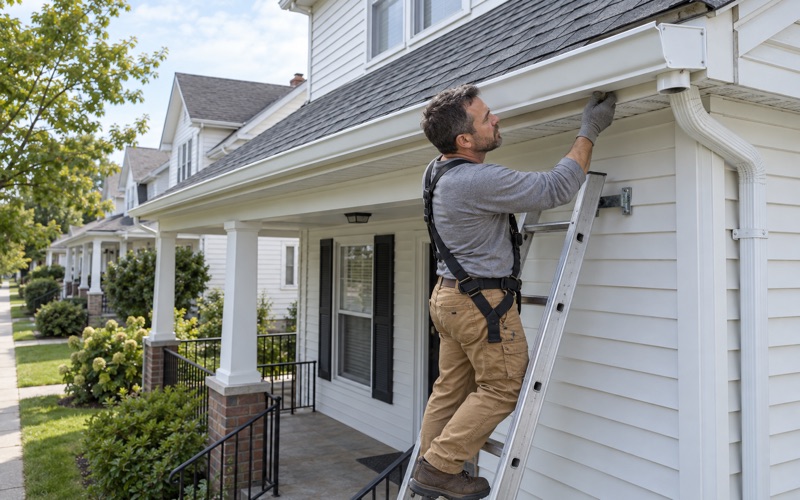
That habit carries into leak calls too. We go into the attic as well as onto the roof, so the water is followed back to the spot where it actually enters before anything gets priced, and you hear plainly whether the roof can be repaired before replacement ever comes up. When a new roof is the honest answer, our written scope puts tear-off, decking, underlayment, flashing, ventilation and gutters on separate lines, so our number can sit beside anyone else’s and be compared one item at a time.
What follows is the part that is particular to this township: how its fee schedule treats a re-roof, what the same schedule says about sellers going door to door, and what the houses themselves tend to ask of a roofer.
Kingston Township’s Roof Replacement Fee Line
The Kingston Township Board of Supervisors sets its permit fees by resolution. The schedule in force is Resolution R-2024-5, which repealed the earlier R-2023-11 and sits in the township’s Administrative Code as its Schedule of Fees.
Roof Replacements Have Their Own Entry
Under item 21, “Exterior Repairs,” R-2024-5 lists Roof Replacements as a line of their own at $10.00 per $1,000.00 of cost. The two lines beneath it, additions to existing buildings and interior or exterior alterations, are set at $15.00 per $1,000.00 of cost.
That split tells a homeowner two useful things. A re-roof is not folded in with a porch addition or a remodel; the township prices it separately and at the lower rate. And because the rate is tied to the cost of the work, the fee follows the size and scope of the job rather than landing as one flat charge for every house.
Surcharges and Neighboring Lines
The same schedule lists two surcharges on building permits: a U.C.C. Surcharge, described as a state-mandated fee, at $4.50, and a Kingston Township Surcharge at $3.50. A few other lines can come into play on a roofing job depending on what it touches, such as $100.00 for demolition of a residential structure and a $65.00 zoning permit listed for chimneys.
We treat these numbers as published rates, not as a quote. Which lines apply to a particular house, and whether a particular job needs a permit at all, is answered by the township’s code and its office, not by the fee table alone.
How We Use the Schedule
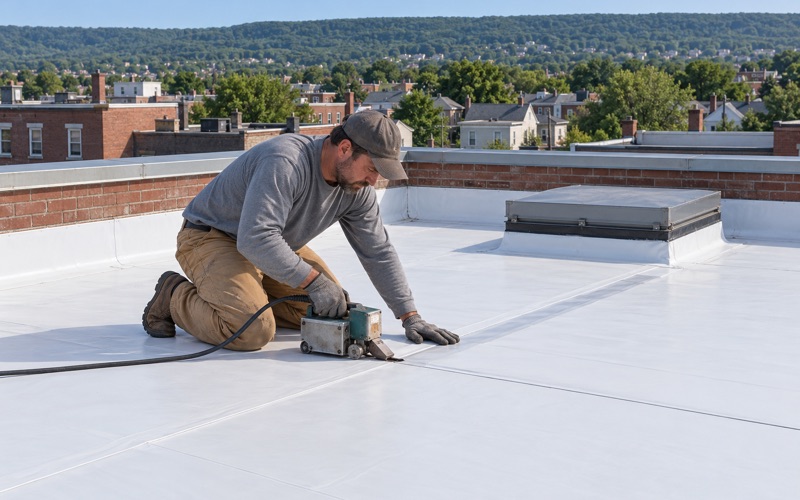
Before we price a re-roof in Shavertown or Trucksville, we confirm with the township what the job requires and carry that into the written scope as its own item. That way the permit is a line you can see, not a surprise folded into a total, and two estimates can be compared on the same footing.
It also keeps the schedule in proportion. The fee is a small part of a re-roof next to materials, labor and disposal, but it is a real part, and leaving it out is one of the easier ways for a low estimate to look lower than it is.
Looking for roofing closer to Forty Fort? See Forty Fort Roofing.
Door-to-Door Roofers and the Transient Retail Business Fee
R-2024-5 does not only cover construction. Item 23, “Transient Retail Business,” lists Soliciting Door to Door at $50.00 per person per day, and a fixed-location seller for 90 days or less at $300.00. In other words, Kingston Township has put a price on selling at the door, and a canvasser working its streets falls under a township fee line.
Why This Comes Up After a Storm
Wind and hail bring knocks on the door. A crew working a street will often point at the roof, mention damage, and offer to start right away. Some of those visits are honest, and some are a fast way to sign a contract before an owner has seen the roof, the attic or a second opinion.
The fee line is a reminder that selling at the door is something the township tracks. It does not settle whether a particular knock is a good deal, and it is no substitute for looking at the work itself.
What We Do on Storm Damage
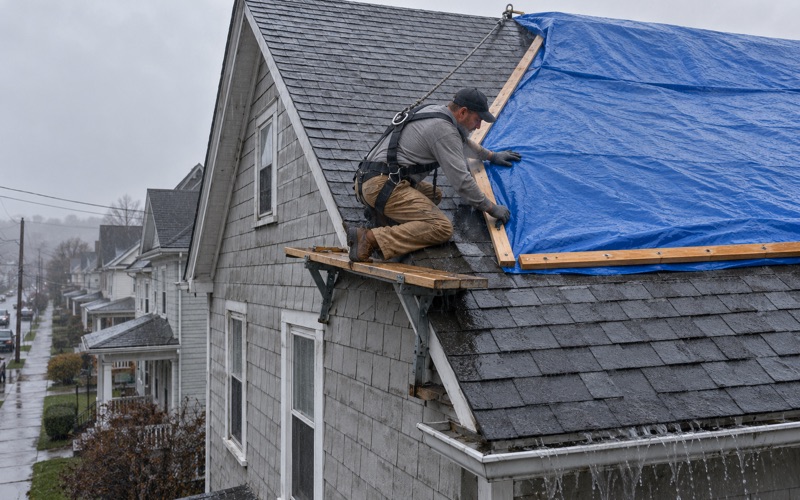
We photograph storm damage and write it up for your own insurance claim, so you have a dated record of what was found and where. If you ask, our crew will meet the adjuster on site and walk the roof with them. We do not negotiate the claim for you; that conversation stays between you and your insurer.
The same attic check applies here as on any leak. Hail bruising or lifted tabs on the surface mean one thing; a stained sheathing board or wet insulation underneath means another, and the scope should match what is actually there.
We also keep repair and replacement separate in what we write up. If a few torn shingles and a failed pipe boot explain the damage, the write-up says so, and you can decide from there whether a full roof is worth pursuing.
Taking Your Time
Whoever you hire, ask for the scope in writing, with tear-off, decking, underlayment, flashing, ventilation and gutters broken out. A roof that needs attention after a storm almost always has time for a second estimate, and a line-by-line scope is the easiest way to see what each offer actually includes.
Back Mountain Houses in Shavertown and Trucksville
Kingston Township is known as the gateway to the Back Mountain, and its two main villages, Shavertown and Trucksville, hold the densest development in the southwest of the township. Farms and forest cover much of the north and south. The housing stock is overwhelmingly single-family: the Census Bureau’s 2024 five-year estimates count 3,079 detached homes out of 3,508 housing units, and 2,606 of 3,336 occupied homes are lived in by their owners.
A 1970s Peak, With Older Neighbors
The largest single building decade is the 1970s, at 880 homes. Another 574 date from the 1950s and 245 from the 1960s, while 444 were built in 1939 or earlier. A house from any of those decades has had time to wear through more than one roof, and we check how many layers are on before we price anything, because the reroofing rules in IRC R908 limit how many can stay on the deck.
When the old layers come off, the decking underneath is what decides the rest of the job. Any damaged sheathing we find is photographed and shown to you before it is replaced, at the per-sheet price written into the contract, so a rotten board never becomes an open-ended charge.
Eaves, Ice and Gutters
Winter ice dams are a familiar problem on older homes in this part of Pennsylvania. We run a self-adhering ice barrier meeting ASTM D1970 up from the eaves, sized to the house’s actual overhang rather than a stock width, in line with the IRC R905.1.2 ice barrier requirement.
Gutters and downspouts get sized and pitched along with the roof instead of being bolted back on as an afterthought. On a re-roof we look at whether seamless aluminum gutters and properly placed downspouts will carry the water off a given roof plane, and we fit drip edge at the eaves and rakes so runoff lands in the gutter instead of behind it.
Ice at the eaves is often an attic problem as much as a roof problem. Warm air leaking into a poorly vented attic melts snow on the upper slope, and the water refreezes at the cold overhang. That is why ventilation is its own line in our scope: we balance a ridge vent against soffit intake by net free area, so the attic stays close to outside temperature and the roof deck stays dry through the winter.
Flashing, Chimneys and Slate
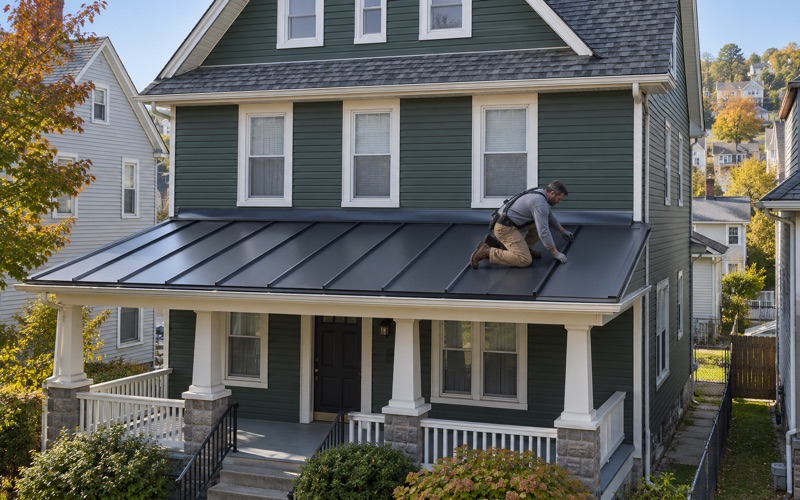
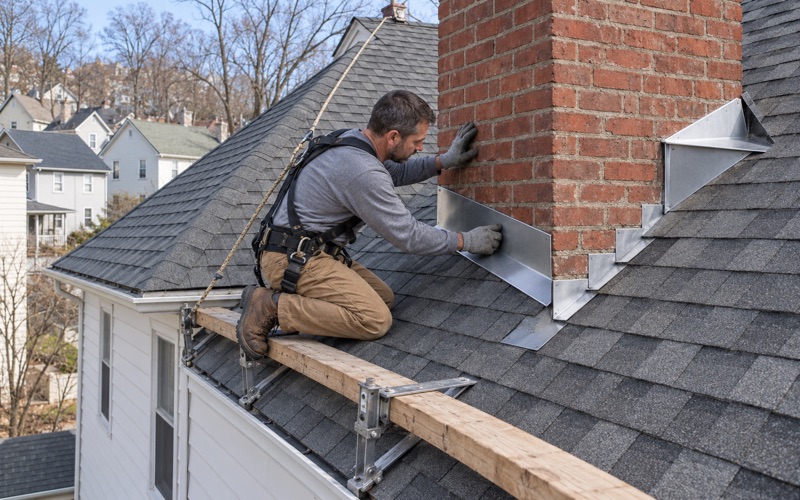
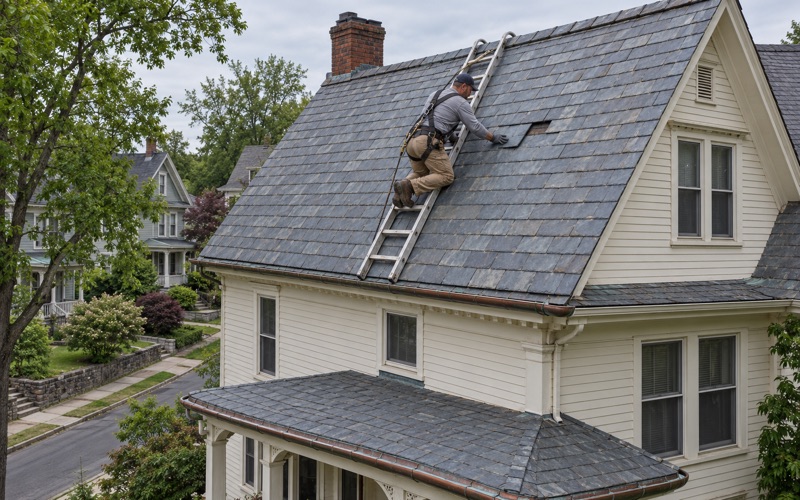
Step, counter and chimney flashing is replaced with the roof, never reused under new shingles. Where a wide chimney sits below a long slope, a chimney cricket keeps water and snow from piling up behind it. On an older house that still carries slate, we repair it slate by slate with copper nails and slate hooks before anyone suggests tearing off a sound roof.
Working With the Township Office on E Center Street
Kingston Township’s administration office is at 180 E Center Street in Shavertown, reachable at (570) 696-3809 and open Monday through Friday, 8:30 a.m. to 4:30 p.m. The township opted in to administering the state construction code on July 7, 2004, so building questions here go to the township itself.
Who Handles What
The state’s municipal list names William Eck as the township’s building code official, at the administration number. Zoning applications go to the office to the attention of Lee Hampton, the township’s Zoning and Code Enforcement Officer, and can be returned in person, by mail or by email.
Knowing which desk handles which question saves days. A re-roof question goes one way; a chimney rebuild or anything that changes the footprint of the house may go another, and we ask before we assume.
Stormwater and Toby’s Creek
R-2024-5 also carries a line for stormwater drainage plans under the Toby’s Creek Stormwater Ordinance. A roof is the largest water-collecting surface on most lots, so when a job changes where downspouts discharge, we raise the question with the township rather than guessing whether that ordinance reaches it.
Keeping the Site Clean
Shavertown and Trucksville are close-built in places, with driveways and yards right below the eaves. At the end of every work day we clean the driveway, yard and gutters and run a magnet sweep for roofing nails, so the property is usable each evening and not only on the last day of the job.
- 20+ Years Roofing
- Free Written Estimates
- Repair Before Replace