Scranton Quality Roofing brings more than 20 years of work to roofing in Edwardsville, and on jobs in this borough the paperwork matters as much as the shingles. Before a crew sets a ladder against a house here, we sort out what the borough office expects from the contractor, the container and any permit the job calls for.
That order is deliberate. Every municipality we serve sets its own re-roof rule, so we confirm the one that governs your address before a number goes on the job. A leak call also starts in your attic as well as on the roof, so the price reflects where the water actually gets in rather than where the stain shows up.
If a repair will hold, you hear that first. Replacement comes up only when the roof genuinely calls for it, and the written scope that follows breaks each part of the work into its own line so nothing is buried in a lump sum.
Edwardsville’s borough contractor’s license and the $500 fine
Edwardsville handles its own code enforcement through the Office of Code Enforcement & Building Inspection at 470 Main Street. The borough opted in to enforcing the state construction code on June 10, 2004, with amendments, and its building permit form spells out who may work inside borough lines.
Every contractor needs the borough’s license
The permit form states in capital letters that all contractors working within the borough must hold a valid borough contractor’s license. The wording covers every contractor, not one trade, and it appears on the same form a homeowner sees when a permit is pulled.
What we have read is the requirement and the penalty, not the license ordinance behind them. We do not quote a license fee or describe an application process, because the borough has not published either where we could verify it. Questions about the license itself go to Code Enforcement at (570) 288-6484.
A state number comes first
The borough’s Permits and Forms page adds a second step. Contractors registered with the state must present their PA number before the office issues a permit, so that number is part of the conversation at the counter on Main Street.
What the fine and the doubled fees cover
The same form sets a $500 fine for working without a license or the necessary permits. That penalty sits on the borough’s own notice, and the code official named for the borough’s code program is David Saraka.
The fee schedule adds a second cost on top of it. Permit fees are doubled for work started before required permits are obtained, so starting first and asking later raises the bill even before any fine is considered.
For us, that settles the sequence. We check the borough’s position on your specific job with Code Enforcement before tear-off is scheduled, and the start date is set after that answer comes back, never ahead of it.
Looking for roofing closer to Pocono Springs? See Roofing in Pocono Springs.
A $25 permit for a roofing dumpster in the street
A full tear-off fills a container with old shingles, underlayment, flashing and nails, and on a house where the driveway cannot take it, the container goes in the street. Edwardsville treats that as its own permit, separate from anything else the job involves.
When the container sits in the roadway
The building permit form calls for separate permits for waste dumpsters in the right of way. The borough’s fee schedule, dated January 2025, prices the waste dumpster in roadway permit at $25.00 per dumpster.
Because the fee is set per container, a job that needs two dumpsters in the street carries two fees. We plan the count with the tear-off rather than on the morning of it, so a second container does not show up without its permit.
Where we place it and how we clear it
If the driveway can hold the container, the street stays clear and the roadway permit never comes into it. If it cannot, the permit is part of the schedule before the truck arrives, and the drop is timed to the tear-off day.
Cleanup runs on a daily rhythm. At the end of every work day the driveway, yard and gutters are cleared, and a magnet is swept across the ground for roofing nails, so loose fasteners do not end up in the yard or the gutter line next to the container.
What comes off the roof
Once the old layers are gone, the decking is exposed for the first time in years. If any of it turns out to be damaged, we photograph it and show you the pictures before a sheet is replaced, and the price per sheet is already written into the contract.
That keeps the container from becoming a surprise line on the final bill. You see what came off, what went back and what each piece cost before the job closes.
Permits valid for one year, posted at the job
When the borough does issue a building permit, its form says the permit is valid for one year and must be displayed at the work site. On a roof job, that means the permit stays visible for as long as the work runs.
We keep a copy of the permit in the job file as well. If a question comes up at the site partway through the work, the answer is on the permit itself rather than in someone’s memory of a phone call.
What the schedule publishes, and what it does not
The residential fee schedule is published rather than quoted case by case. It runs $50 for work up to $500, then $75, $100, $150 and $200 in steps up to $10,000, with inspection fees included, plus $7 for each $1,000 above $10,000.
We point owners to that schedule instead of guessing at a figure, because the amount depends on the declared value of the work. Edwardsville also has not published a list of which work requires a building permit, and its materials carry no roofing item, so the answer for a given roof comes from the code office rather than from a rule of thumb.
Appeals go to the Code Hearing Board
A decision from the borough’s code office can be appealed. The permit form sends appeals to the Edwardsville Borough Code Hearing Board within 15 days, which is a short window for anyone who has to assemble paperwork after the fact.
Our written scope helps there. Tear-off, decking, underlayment, flashing, ventilation and gutters each sit on their own line, so the description of the work is clear enough to compare against a second estimate item by item and clear enough to show anyone asking what the job covered.
Electrical work is inspected separately
The same permit form notes that the borough does not perform electrical inspections. If a roof job adds a powered attic fan or other wiring, that piece goes to a certified third-party inspector, and we flag it in the scope so it is not missed.
Edwardsville’s pre-1940 and 1970s housing along Route 11
Edwardsville is a borough in Luzerne County, settled in 1768 and incorporated in 1884. It covers about 1.24 square miles, with the Susquehanna River on its southern border and U.S. Route 11 passing through, and it is part of the Wyoming Valley West School District.
Two building eras shape the work
Census estimates show two clear peaks in the housing stock: 707 homes built in 1939 or earlier and 749 built in the 1970s. No other decade comes close, so most roofs we see here belong to one era or the other.
Of 2,085 occupied homes, 1,136 are renter-occupied, and a large share of those sit in two-unit buildings and apartment buildings rather than detached houses. That mix changes who calls us, since an owner-occupant, a landlord or a property manager may each be the person approving the roof.
The pre-1940 houses
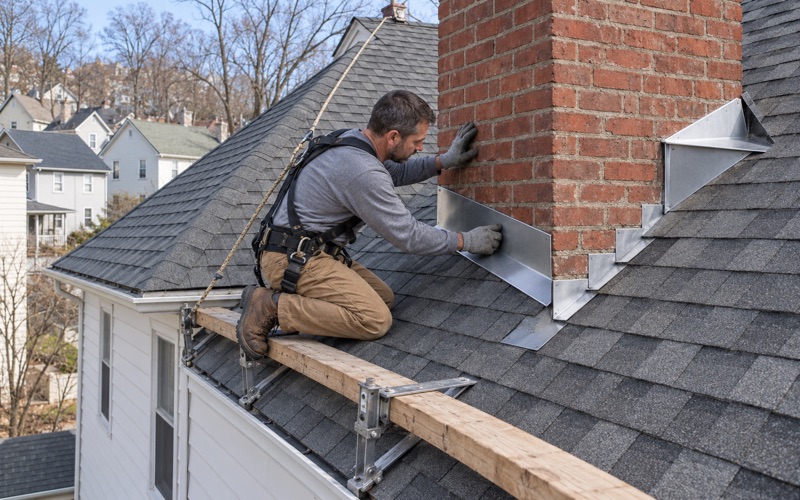
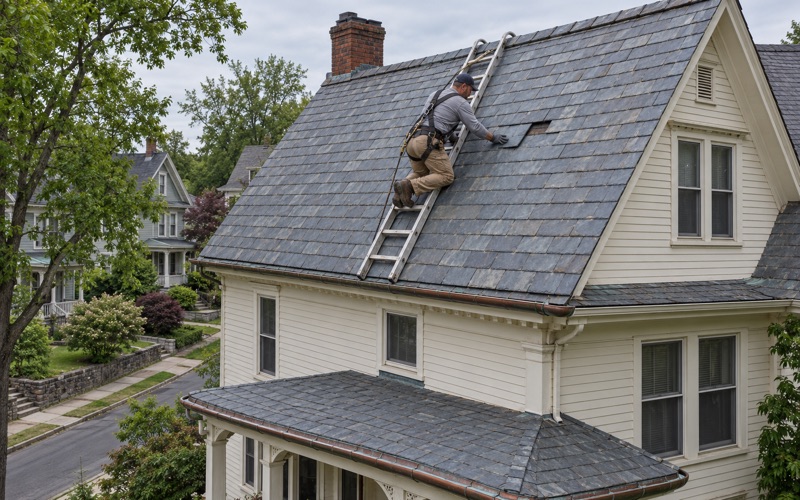
A house built before 1940 may still carry slate, and where the slate is sound, we repair it slate by slate with copper nails and slate hooks before anyone suggests tearing it off. Chimneys on houses of that age are a common entry point for water, so step, counter and chimney flashing is replaced with the roof rather than reused under new material.
Painted trim and fascia on these homes are handled under the EPA RRP lead-safe rule for pre-1978 houses. That applies whenever the work disturbs old paint at the roof edge, not only on a full replacement.
The 1970s houses
The 1970s stock tends to raise questions about layers, ventilation and drainage. We check ridge vent against soffit intake, and gutters and downspouts are sized and pitched with the roof instead of being treated as an afterthought. Where a second layer of shingles is already in place, we explain what the existing layers mean for the job before pricing it, since that answer decides whether a full tear-off belongs in the scope.
Eaves on these houses get a self-adhering ice barrier sized to the actual overhang, because ice dams are a normal part of winter on older homes in this part of Pennsylvania. When a storm does damage, we photograph it and write it up for your own claim, and the crew will meet the insurance adjuster on site if you ask, without negotiating the claim for you.
Where the roof water goes
Toby Creek runs through an underground culvert system before it daylights in the borough behind the K-Mart Shopping Plaza, then meets the Susquehanna River at the borough’s edge. The creek has been channelized for much of its length and relocated in places. For a roof, the practical point is at ground level: downspouts are pitched and placed so the water they carry leaves the house where the yard can take it.
- 20+ Years Roofing
- Free Written Estimates
- Repair Before Replace