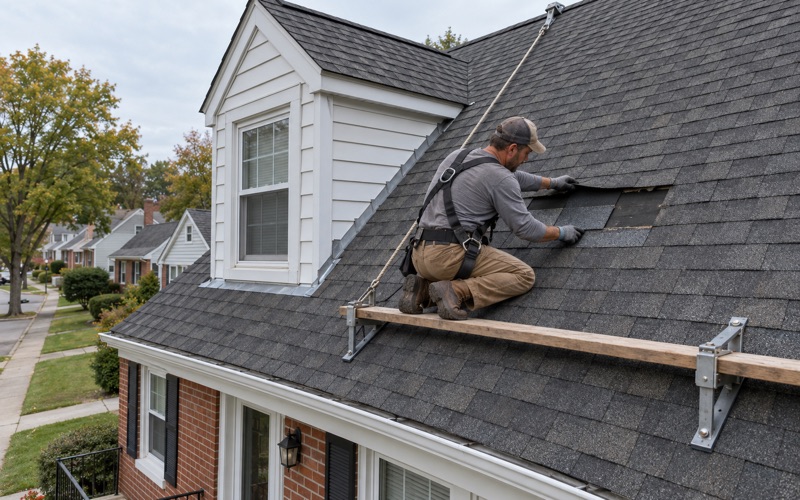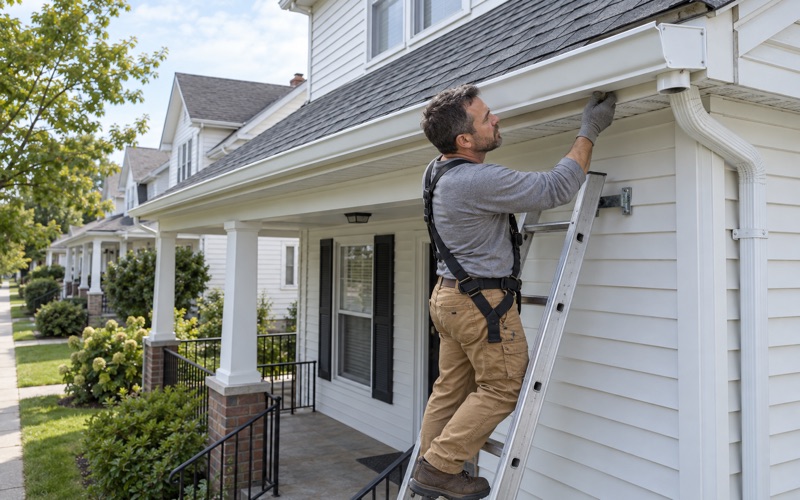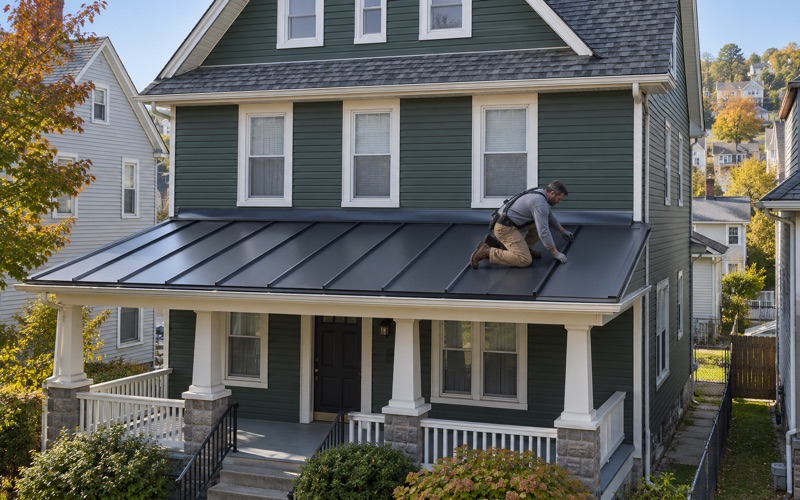
Scranton Quality Roofing brings more than 20 years of roofing in Dallas Township to every call, and a leak visit here starts in the attic as often as it starts on the shingles. We follow the water stain back along the rafters and sheathing to the spot where it actually enters before anyone prices a fix. On a roof that has been patched more than once, the drip over a bedroom ceiling can sit several feet from the gap that let it in.
You get a plain answer on whether the roof can be repaired before replacement is ever raised. When a new roof really is the better spend, our written scope lists tear-off, decking, underlayment, flashing, ventilation and gutters as separate lines, so a second contractor’s number can be laid beside ours and checked item by item.
Houses make up most of our work in the township, but they share the map with a university campus and a former printing plant on the main highway. The sections below cover that mixed building stock, the township’s rule on roofing materials left outside, and who signs off on the paperwork at the municipal building.
Misericordia University and the Payne Printery on Route 415
A campus that has kept building since 1924
Misericordia University sits mostly inside Dallas Township, including all of the census-designated place that carries its name. The Religious Sisters of Mercy founded it on September 15, 1924 as College Misericordia, and it became a university on August 24, 2007. The grounds now cover about 120 acres around 301 Lake Street, and the school counted 2,202 students in fall 2025.
From a roofer’s point of view, the striking thing is how many building eras share one campus. Halls and the Henry Science Center were added between 2009 and 2021, and a Multi-Purpose Dome went up in 2024. Roofs installed decades apart age on different clocks, which is why institutional property in the township is never a single maintenance schedule.
A printing plant turned into university space
In 2019 the university bought the former Payne Printery at 3235 Memorial Highway, on Route 415. The building runs about 40,000 square feet, and at its peak Payne employed about 130 people across three shifts. On March 18, 2019, the township’s Zoning Hearing Board took up the university’s request as Case #1, a special exception to convert the building from commercial printing and warehouse use.
The board granted it with three stipulations. The approved uses were athletic practice space, two occupational therapy labs, clinics and faculty offices, with 63 parking spaces on the site. A structure planned around presses and pallets now holds labs and treatment rooms, and that kind of change in use is part of how buildings along Memorial Highway get reworked rather than replaced.
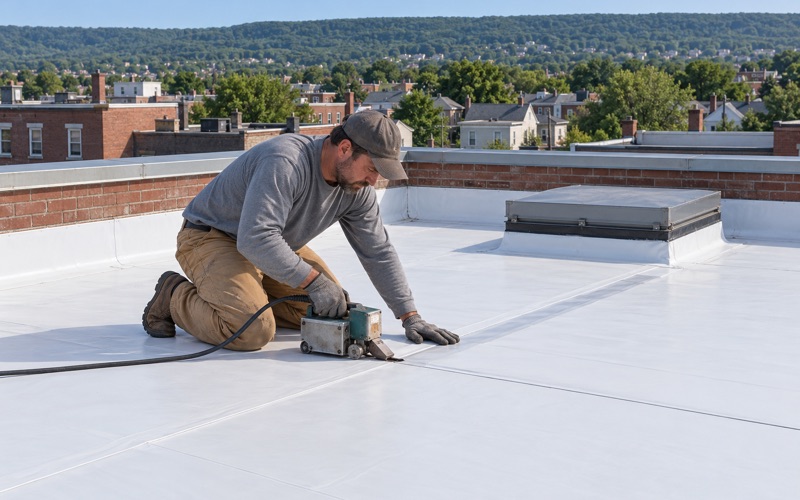
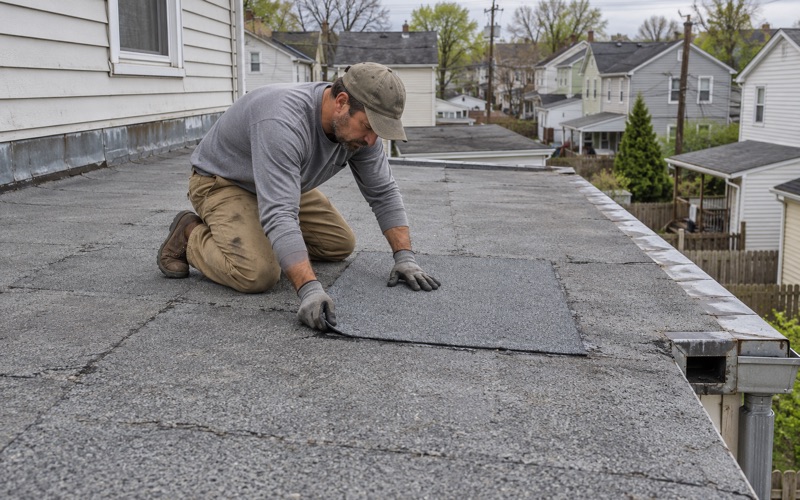
Large commercial and institutional buildings commonly carry low-slope sections, and those call for different materials than a pitched house roof. EPDM rubber, TPO and PVC single-ply membranes, and torch-down modified bitumen each have their place, and the right one depends on the deck, the drainage and how much foot traffic the roof sees from mechanical equipment. We explain the tradeoffs in writing so an owner or facilities manager can weigh them against another bid.
Student homes near the campus
The university’s reach extends into nearby streets as well. In January 2025 the township enacted an ordinance on student housing, and its Student Rental Permit Application lists Student Home as a use permitted by special exception in the C-1, A-1, A-2, R-1, R-2, R-MPH and S-1 districts, decided by the Zoning Hearing Board. For an owner of a house rented to students, the roof is one piece of a property that already goes before that board, so we keep the written scope and photos in a form that is easy to hand over.
Looking for roofing closer to Edwardsville? See Edwardsville Roofing.
The houses of the Back Mountain
What the census says about the township’s homes
Dallas Township covers 19.0 square miles of the Back Mountain, a 118 square mile region in northern Luzerne County, and was formed in 1817 from Kingston Township. It counted 9,099 residents in the 2020 census and runs north to the village of Kunkle. The 2024 five-year American Community Survey puts 2,714 of its 3,686 housing units in detached single-family houses, and 2,828 of 3,369 occupied homes are owner-occupied.
The age spread is wide. The survey counts 658 homes from the 1970s, 544 from the 1950s, 540 from the 1980s and 399 built in 1939 or earlier, against 246 built since 2010. The median owner-occupied value is $267,600, which tells us most owners here are weighing a repair or a replacement against a house worth protecting properly.
Eaves, ice and flashing
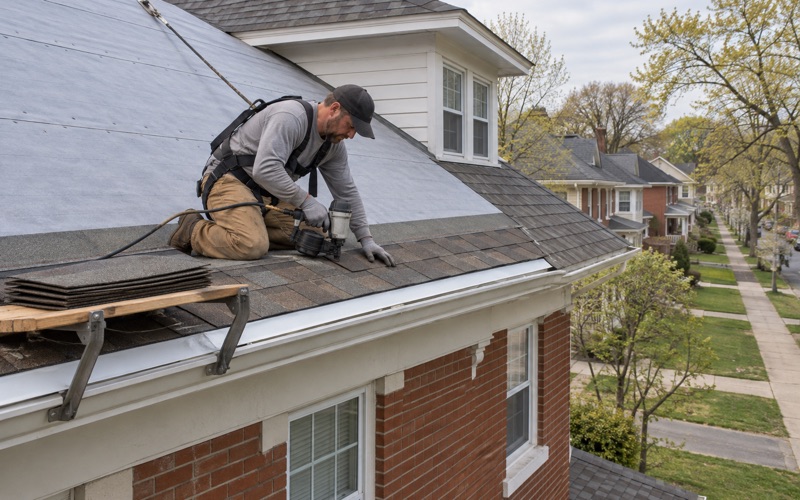
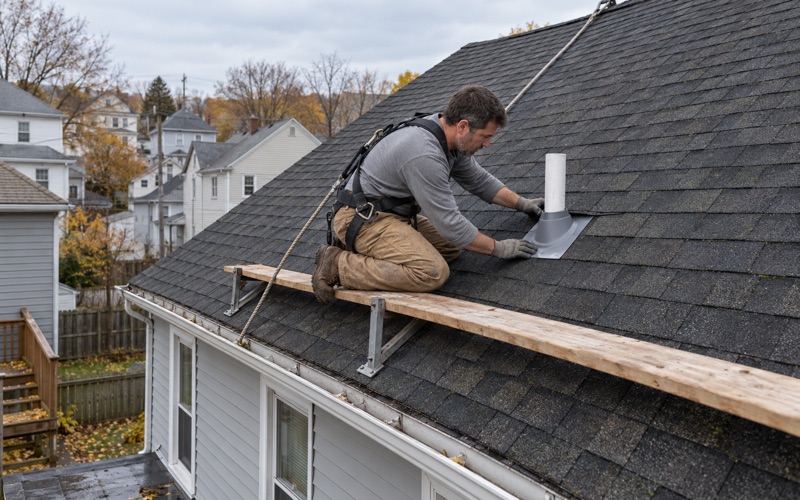
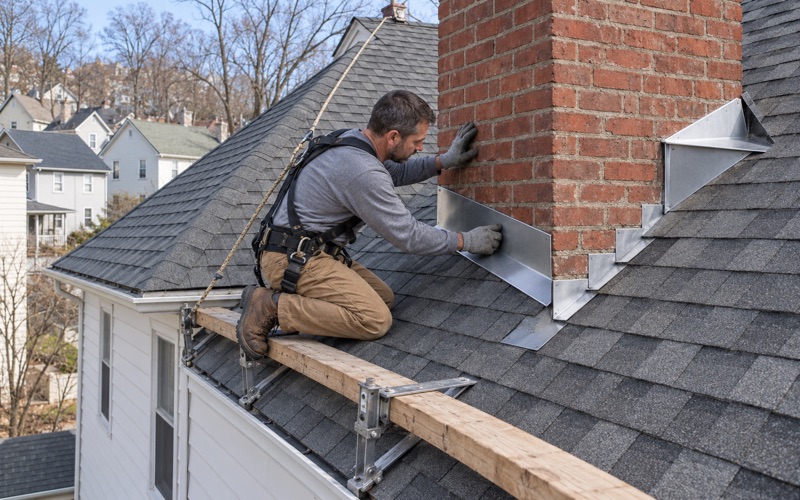
On every house we roof, the eaves get a self-adhering ice barrier sized to the actual overhang, because the winters in this part of Pennsylvania build ice dams along the eaves of older homes. Step, counter and chimney flashing comes off with the old shingles and is replaced, not bent back into place under new material. A chimney cricket goes in where a wide chimney sits across the slope and would otherwise hold water and snow.
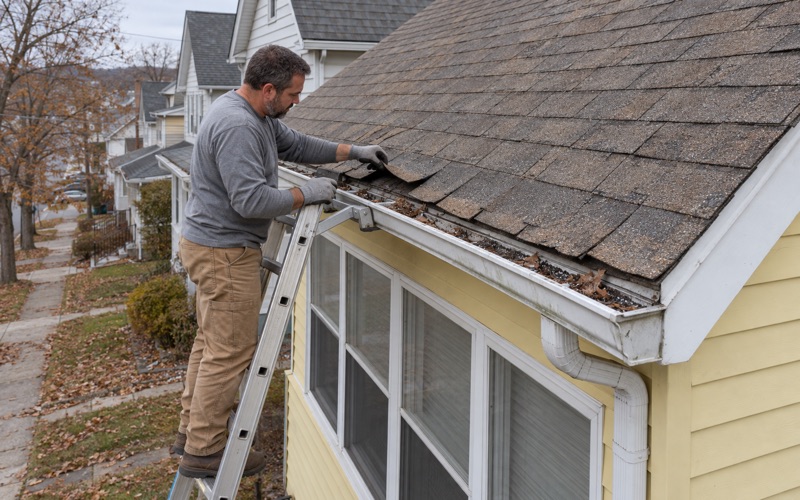
Gutters and downspouts are sized and pitched with the roof rather than added as an afterthought. On a 1950s ranch or a 1970s split-level, a gutter that has sagged out of pitch is often the reason the fascia and the first course of decking are soft.
Ventilation gets the same attention. A ridge vent only works with enough soffit intake below it, so we check the net free area at both ends of the attic instead of assuming the old vents were sized right. An attic that cannot breathe holds moisture against the underside of the decking and warms the roof deck enough to feed the ice dams the eave barrier is there to stop.
Decking we find after the tear-off
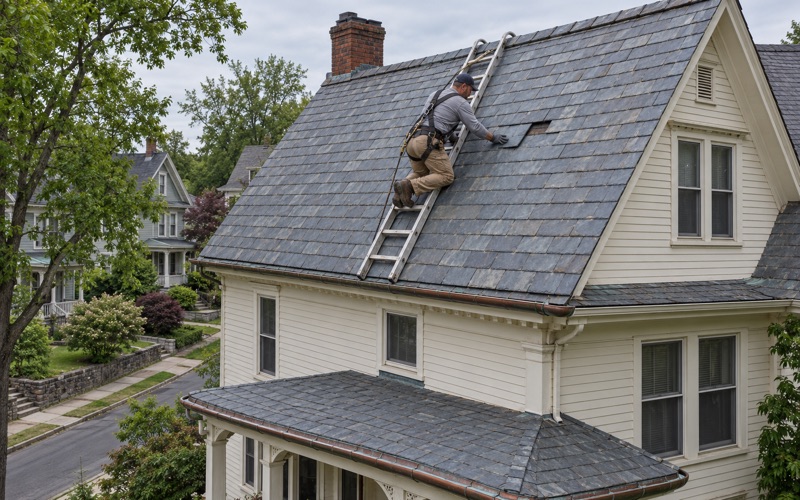
A tear-off sometimes exposes sheathing that cannot hold a nail. When that happens we photograph the damaged sheets and show them to you before anything is replaced, and the per-sheet price is already written into the contract. On the pre-1940 houses that still carry slate, we repair slate by slate with copper nails and slate hooks before anyone suggests stripping a sound slate roof.
Dallas Township’s 60-day rule for shingles stored outside
What Ordinance No. 2 of 2023 says
The township adopted the 2021 International Property Maintenance Code as the International Property Maintenance Code of Dallas Township through Ordinance No. 2 of 2023, enacted April 4, 2023. It added section 302.10: construction materials, “including, but not limited to, lumber, shingles, etc., shall not be stored at the exterior of any premises for a period exceeding sixty (60) days, unless approved in writing by the code official.”
The ordinance defines stored as not used for more than seven consecutive days. Fines under the ordinance run $300 to $500 per day, so a pallet of leftover bundles behind a garage is not a harmless habit here.
How we keep materials moving
We schedule shingle and underlayment deliveries close to the start date, so bundles go from the truck to the roof rather than sitting in the driveway. Unopened leftovers leave with our crew when the job wraps up instead of being left for the owner to deal with later.
If a job has to pause for weather or a backordered material, we talk through the timing with you rather than letting stock sit outside and drift toward the limit. A homeowner who is buying materials for a later project should know about the rule before the delivery arrives.
Cleanup at the end of each day
The driveway, yard and gutters are cleaned at the close of every work day, and a magnet sweep picks up the roofing nails that hide in grass and gravel. Debris from the tear-off is cleared as we go so the property looks like a job site for as short a time as possible.
Permits and contractor registration at 105 Lt. Michael Cleary Drive
Who enforces the building code
Dallas Township opted in to the Pennsylvania Uniform Construction Code on July 1, 2004, with no local amendments, and code enforcement runs out of the municipal building at 105 Lt. Michael Cleary Drive. The state’s listing names Russ Coolbaugh at (570) 674-2000 as the contact, and the township’s permit application names Jason Humenanski as building inspector.
The township’s published materials do not state whether a re-roof by itself needs a permit. Because every municipality in our service area sets its own re-roof rule, we check the answer with the township office for your address before the job is priced, so the permit question is settled in writing rather than guessed.
What the permit application asks for
The building permit application sets residential fees from $24.50 for work up to $500 to $184.50 for work between $9,000.01 and $10,000. Above that, the fee is $200 plus $7.50 for each additional $1,000, plus a $4.50 state fee, and each failed inspection adds $65.
The application warns that fees are doubled for anyone who starts work before securing a required permit. Its wall-envelope sheet asks for the roof sheathing, roof underlayment and roof covering, which is the same information our written scope already breaks out line by line.
Registering as a contract worker
The township’s ordinances page states that all contract workers in Dallas Township must register with the Zoning & Code Enforcement Officer. That is a township registration step, not a state roofing license, and it is a fair question to ask any roofer before signing.
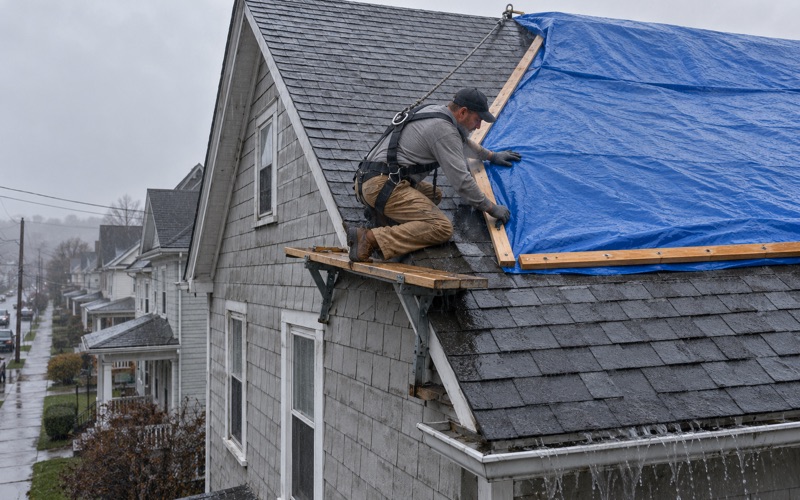
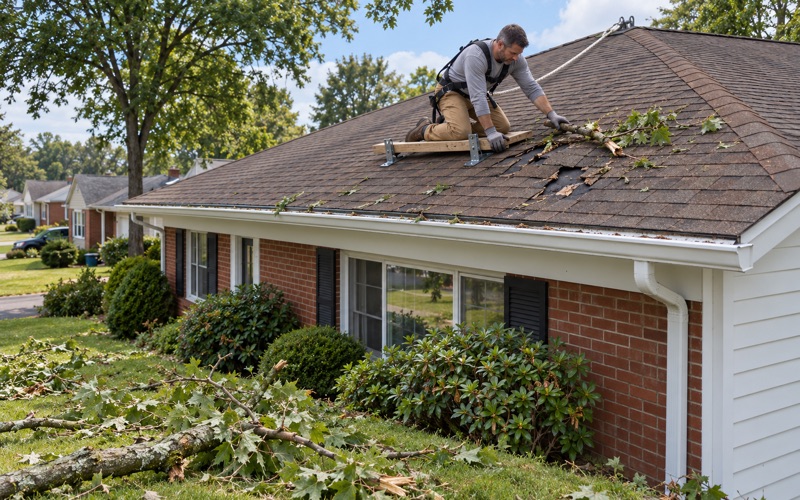
When storm damage is behind the call, we photograph it and write it up for your own insurance claim. If you ask, our crew will meet the adjuster on the roof, though the claim itself stays between you and your insurer.
- 20+ Years Roofing
- Free Written Estimates
- Repair Before Replace