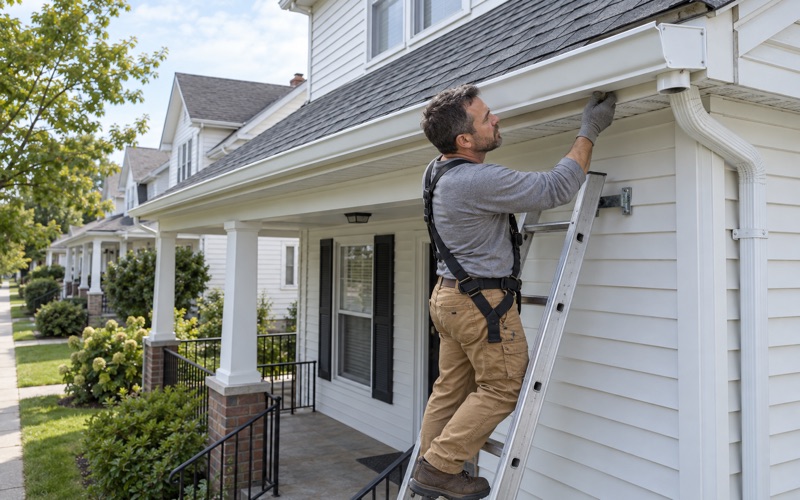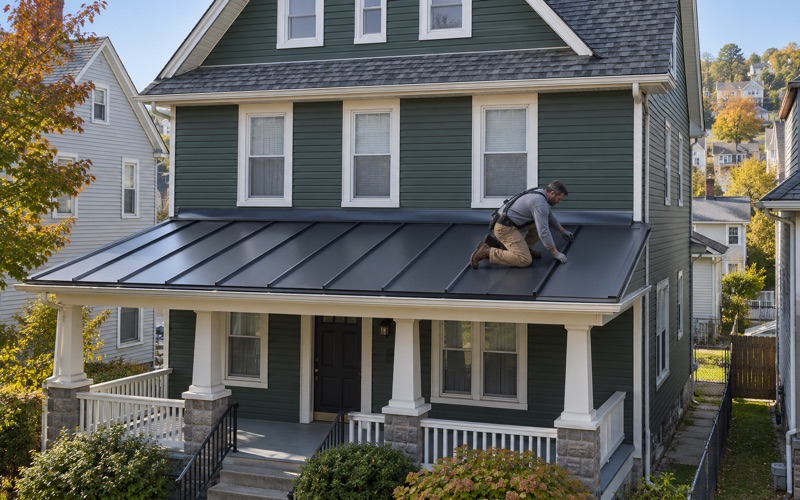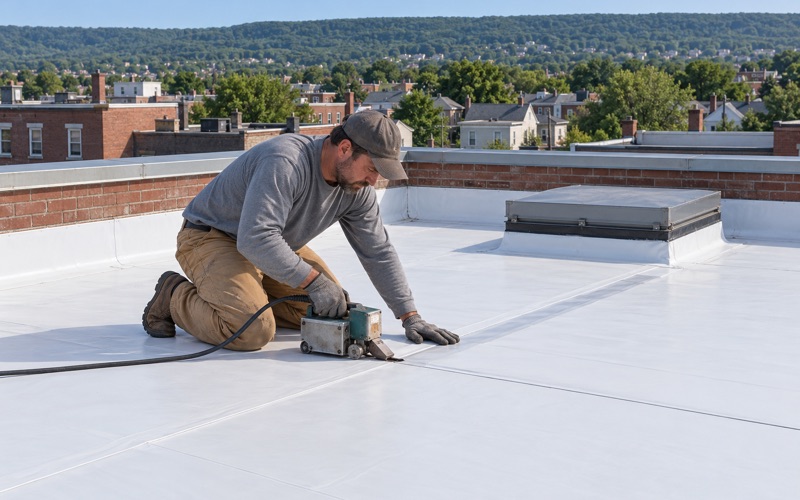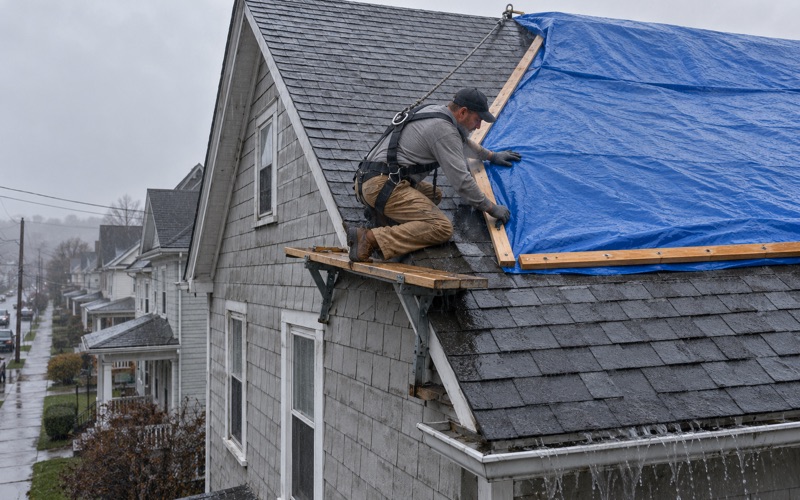
Scranton Quality Roofing has been doing roofing in Carbondale and the rest of the Lackawanna Valley for more than 20 years, and our first visit to a house always aims at two answers: where the water is really coming in, and whether the roof can be fixed instead of replaced. On a leak call we go up into the attic as well as out onto the shingles, because a stain on a bedroom ceiling rarely sits directly under the opening that caused it.
If a repair will do the job, you hear that from us before anyone mentions a new roof. If replacement is the better call, the written scope separates tear-off, decking, underlayment, flashing, ventilation and gutters into their own lines, so you can set another contractor’s estimate beside ours and compare it one item at a time.
The permit is part of that price from the beginning. Carbondale writes its own rule for re-roofing, and we confirm what the city asks for at your address before quoting, so the paperwork is filed and posted before the first shingle comes off.
The West Side Mine Fire and the 1987 Bureau of Mines Study
Few towns we work in carry a history like the one under Carbondale’s West Side. It is worth knowing as a homeowner here, and it is also worth knowing what the record actually says, because the story gets retold with very different numbers.
From a 1946 dump fire to the coal workings
According to U.S. Bureau of Mines Report of Investigations 9421, published in 1992, a 1946 city dump fire spread into the underground coal mine workings beneath the neighborhood. Crews tried to put the mine fire out by flushing in 1950, and tried again by excavation in 1974.
That excavation left its mark on the land itself. The report describes 11 three-story apartment buildings standing on ground that had been stripped and backfilled during an earlier fire-control project, and the study site sat right beside that apartment complex.
Boreholes, methane and heated zones
In 1986, OSMRE installed 34 monitoring boreholes across about 8-1/2 acres there, and the Bureau of Mines carried out its diagnostic study in February 1987 at OSMRE’s request. After analyzing 25 communication tests, the researchers defined two large heated zones of about 100 by 250 feet and five small, isolated ones, all marked by elevated methane readings.
The first clue had come in winter. People noticed unusual patches where snow melted on the ground over the site, and the report found an approximate match between those melt areas and the heated zones it mapped below.
What we take from it as roofers
The snow melt in that study was on the ground over the fire site, not on anyone’s roof, and the federal account ends with its 1992 publication. Other sources give different figures for the fire’s toll and for when it was finally out, so we stick to what RI 9421 recorded.
What the history does explain is the West Side’s layout today: rebuilt ground, newer buildings on reclaimed land, and older houses around them. When we look at a roof in that part of the city, we judge it on what we can see and measure, the deck, the flashing, the ventilation and the age of the covering, the same as on any other street in Carbondale.
Looking for roofing closer to Kingston? See Roofing Services in Kingston.
Carbondale’s Own Roof Permit, and How the Fee Bands Work
The city keeps a dedicated Roof Permit separate from its general building permit, and the city’s permit FAQ is blunt about it: almost everything in Carbondale requires a permit. Painting and carpeting are the only items it lists as needing none.
What the Roof Permit covers
The city’s form says the permit is issued for removal and replacement of roofing materials that the Uniform Construction Code exempts. A standard tear-off and re-shingle, with new underlayment, drip edge and flashing, falls under it.
The same form draws a firm line: any work on rafters, trusses or complete sheathing replacement requires a UCC building permit. For the City of Carbondale, those UCC building permits run through Northeast Inspection Consultants, known as NEIC, which the city names for building, electrical, plumbing, mechanical and fire work.
When the deck turns out to be worse than expected
This is where the photo rule in our contracts matters. If damaged decking turns up once the old roof is off, we photograph it and show you before replacing it, at a per-sheet price already written into the contract. A few sheets swapped out is ordinary re-roofing.
If the photos show the whole deck has to go, or a rafter needs structural work, the job has crossed into UCC territory. We stop, explain what changed, and handle the building permit through NEIC before that part of the work moves ahead.
Reading the fee schedule
Carbondale’s published Roofing Permit Fees start from a $75.00 base and add $10.00 for each $2,500 of job cost, figured on the total for labor and materials. The schedule lists a total of $85.00 for a job up to $2,500, $175.00 for a job between $22,501 and $25,000, and $275.00 for one between $47,501 and $50,000.
Above $50,000, the fee rises $15.00 for every additional $5,000. We put the band that matches your contract total on the estimate as its own line, so the permit cost is never a surprise added at the end.
Posting it and reaching the city
The form states the permit must be posted on or in a first-floor door or window, and we post it before work starts. City Hall is at 1 N. Main Street, and the permit office answers at (570) 282-4632, extension 130. If the dumpster has to sit in the road rather than in your driveway, the city charges a separate $25 permit for that, which we arrange as well.
Older Houses and Two- to Four-Unit Buildings
Carbondale’s housing leans old. Census figures from the 2024 American Community Survey count 1,584 of the city’s 4,224 homes as built in 1939 or earlier, more than a third of the stock, with only a small share built since 2000. The same survey puts most of the rest between 1940 and 1989, so a house with an original deck and several generations of roofing over it is the norm here, not the exception.
What a pre-1940 roof tends to need
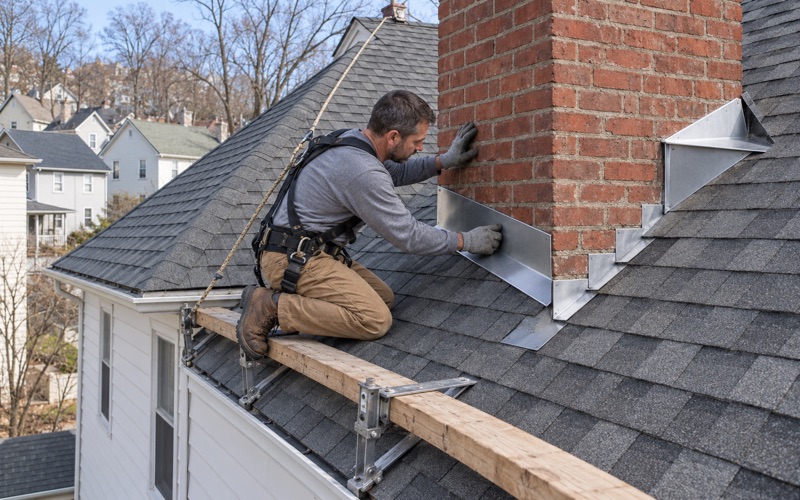
A house that age has usually been roofed several times, and each round leaves its mark: patched boards, old flashing reused under newer shingles, and valleys that have been built up layer on layer. We replace step, counter and chimney flashing along with the roof instead of tucking the old metal under new material.
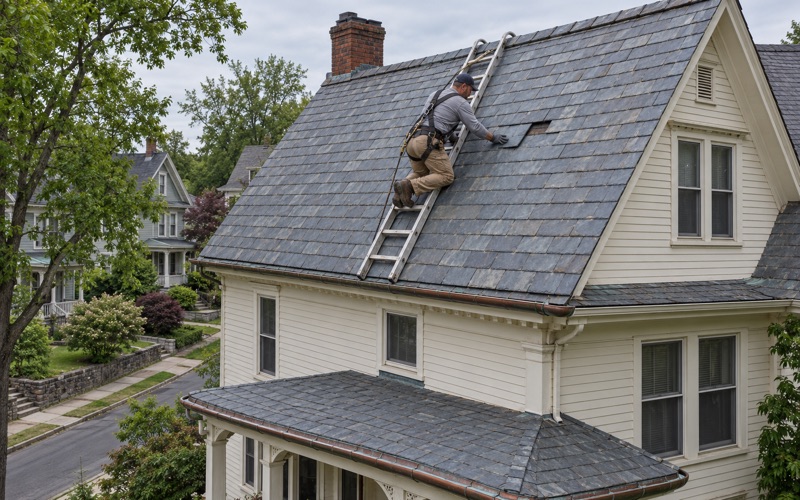
Where a slate roof is still sound, we repair it slate by slate with copper nails and slate hooks before anyone talks about tearing it off. On painted trim and fascia from before 1978, we follow the EPA’s lead-safe RRP rules when that wood is disturbed.
Rentals with two to four units
Roughly half of Carbondale’s occupied homes are rented, and much of that rental stock sits in two-unit and three- or four-unit buildings rather than large complexes. These are often older frame houses split into apartments, with tenants living under the roof while we work.
For owners of those buildings, we schedule around the people inside, keep entrances clear, and clean the driveway, yard and gutters at the close of every work day, including a magnet sweep for nails. Gutters and downspouts get sized and pitched along with the roof, since a multi-unit house sheds a lot of water off one roofline.
How a Carbondale Roofing Job Runs With Us
The local details above shape the paperwork and the scope, but the work itself follows a routine we keep the same from house to house.
Ice at the eaves
Lackawanna Valley winters build ice dams on older homes, and Carbondale’s are no exception. On a replacement, we run a self-adhering ice barrier at the eaves, sized to how far your house’s overhang extends rather than a one-size strip, and we match it with drip edge and balanced ridge and soffit ventilation. In the attic, we check that the soffit intake is actually open, since insulation packed against old eaves is a common reason warm air reaches the underside of the roof deck and starts the melt-and-refreeze cycle.
Storm damage and your claim
After wind or hail, we photograph the damage and write it up so you have a clear record for your own insurance claim. If you ask, our crew will meet the adjuster at the house and walk the roof with them. We document and explain what we find; the claim itself stays between you and your insurer.
That write-up follows the same line items as our estimates, so the shingles, underlayment, flashing and gutters an adjuster sees in the photos match the scope we would price. If the damage turns out to be limited to a few tabs or one slope, the report says that too, and we recommend the repair rather than a full replacement the storm did not cause.
The contract you sign
Every contract we write carries the three-business-day cancellation notice, and deposits stay inside the limit the law allows. Combined with the line-item scope and the per-sheet decking price, that means you know before signing what the job includes, what could change, and what each change would cost.
Whether the call is a single leak over a back bedroom or a full tear-off on a three-unit house, the first step is the same: we come out, look from the attic and the roof, and tell you plainly whether it needs a repair or a replacement.
- 20+ Years Roofing
- Free Written Estimates
- Repair Before Replace