Roofing in Archbald means working on a borough of mostly detached houses whose ages run from before 1940 to the present decade, and that spread is what Scranton Quality Roofing plans every job around after more than 20 years in the trade. A roof framed in the 1920s and one framed in the 1990s wear out in different places, sit on different decking and call for different conversations about repair. We start each Archbald estimate by finding out which kind of house we are standing on.
When a homeowner calls about a leak, we go into the attic as well as onto the roof, because a stain on a bedroom ceiling rarely sits directly below the opening that caused it. Once the water is traced to its real entry point, we tell the owner plainly whether a repair will hold. Replacement only comes up when a repair honestly will not do the job.
The borough also keeps its own roof paperwork. Archbald lists a Roof Work Permit among its forms, so we confirm what the borough office wants for the specific job before a price goes on paper. The sections below cover the state park inside the borough, the houses we work on here, and how a re-roof moves through the borough office.
Archbald Pothole State Park on Business Route 6
A 150-acre state park inside the borough
Archbald has a state park within its own limits. Archbald Pothole State Park covers 150 acres on US Business Route 6, and the Pennsylvania Department of Conservation and Natural Resources runs it through its Bureau of State Parks. Hunting is one of the park’s listed activities, so the acreage is more than a roadside overlook.
None of that changes how a roof goes onto a house in Archbald, and we will not pretend it does. What the park does tell a visitor is that this borough carries a long, specific history. It is worth knowing about before you ever think about shingles.
A pothole 38 feet deep
The pothole itself is the reason the park exists. It is 38 feet deep and elliptical, measuring 42 by 24 feet at its widest and narrowing to 17 by 14 feet at the bottom. The park’s own description puts its volume at about 18,600 cubic feet, and it formed during the Wisconsin Glacial Period, around 15,000 years ago.
Thirty-eight feet is deeper than a typical two-story house is tall, which is a fair way to picture it from the rim. People come from well beyond the borough to look down into it. For a geological feature that old, it sits remarkably close to everyday traffic on Business Route 6.
Patrick Mahon and the 1884 mine shaft
Coal miner Patrick Mahon found the pothole in 1884 while extending a mine shaft. For a short time it served as a mine ventilation shaft. The owner, Colonel Hackley, fenced it and built a retaining wall around it three years later, and his widow deeded the site to the Lackawanna Historical Society during 1914.
Lackawanna County made it a county park after adding 150 acres, the land was deeded to the Commonwealth later, and it was dedicated a state park during 1964. That history belongs to the park, not to the houses around the borough. Nothing in the record ties the old shaft to the condition of any roof today, so we judge every Archbald roof on what we actually find on it.
Looking for roofing closer to Exeter? See Roofing in Exeter.
Archbald Homes From Before 1940 to the 1990s
Archbald was first settled as White Oak Run, largely by Irish Catholic families fleeing the Great Famine, and was later renamed for James Archbald, the first mayor of Carbondale. The housing that grew up since then is mostly single-family. The 2024 American Community Survey counts 2,851 detached houses among 3,422 homes, or 83.3%, and about 76.4% of occupied homes are lived in by their owners.
The 931 houses built in 1939 or earlier
The largest single age group in the borough is also the oldest. The survey counts 931 homes built in 1939 or earlier, and those roofs have usually been redone more than once. On a house that age we expect board sheathing rather than plywood, and sometimes an earlier layer still sitting under the current shingles.
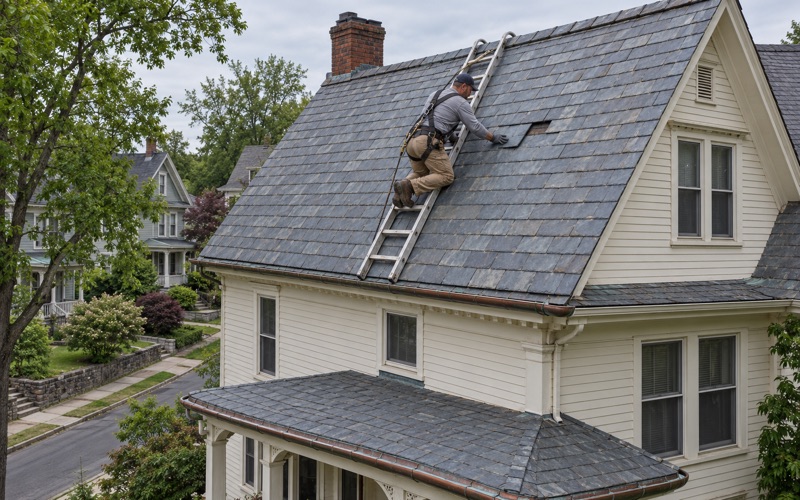
When the old roof comes off, any damaged decking is photographed and shown to the owner before a single board is replaced. The per-sheet price is already written into the contract, so there is no surprise number on the last day. If the house still carries slate on a porch or a dormer, we repair it slate by slate with copper nails and slate hooks before anyone talks about removing it.
The 592 houses from the 1990s
The next-largest decade in the count is the 1990s, with 592 homes built from 1990 through 1999, about 17.3% of the borough’s housing. Those houses typically went up with plywood or OSB decking under asphalt shingles. Many of them are now on their first or second roof, and the original materials are reaching the end of their service.
On these roofs the questions shift. We check whether the attic ventilation actually moves air from the soffit intake to the ridge vent, and we look closely at pipe boots and at the flashing where a later addition meets the main roof. A 1990s roof that is wearing out evenly across every slope is often a straightforward replacement, and we say so.
Everything in between
The rest of Archbald’s stock fills the decades between those two groups, from 396 homes of the 1940s to 87 built since 2020, plus 222 attached houses and a handful of small multi-unit buildings. That mix means two neighboring houses can need entirely different scopes. A shared price per square rarely describes either of them well.
Our written scopes list tear-off, decking, underlayment, flashing, ventilation and gutters as separate lines for exactly that reason. An owner comparing our estimate against another bid can line them up item by item. If one bid leaves out decking or ventilation, the gap shows up on the page instead of on the final invoice.
The Roof Work Permit and the Code Official on Church Street
Archbald handles its own building code work. Pennsylvania’s municipal election records show the borough opted to enforce the Uniform Construction Code locally on May 19, 2004, with no local amendments. The code official works out of the borough office rather than through an outside inspection agency.
What the Roof Work Permit form tells us
The borough’s Forms and Ordinances page lists a Roof Work Permit among its documents. That title is what we know for certain, and it is enough to tell us roof work in Archbald has its own form. We do not guess at the rest, and we would rather check than assume.
Because each municipality in our service area writes its own re-roof rule, we confirm Archbald’s current requirement for the specific job before we price it. If the borough wants the form filed for that scope, the owner hears it at the estimate. The paperwork becomes part of the plan rather than a delay discovered once the crew is already on the driveway.
The Zoning and Building Code Official
The borough’s Departments page lists a Zoning and Building Code Official, reachable through the borough office at (570) 876-1800, extension 102. Pennsylvania’s code enforcement contact list names Brian Dulay as the code official at that same number. That is the office that answers questions about how a roof project fits the borough’s process.
Having the official in-house means a roofing question goes to one desk in the borough itself. We would rather ask a direct question early in the planning than assume an answer and correct it partway through a tear-off. A short call before the estimate saves the owner time once work begins.
Paperwork at 400 Church Street
The borough office sits at 400 Church Street, Archbald, PA 18403, and that is where a form gets picked up, filed or asked about. When paperwork applies to a job, we tell the owner who handles it and what it covers. Nobody should learn about a borough form from a notice taped to the front door.
We also keep the paperwork separate from the price. The estimate lists what the roof needs, and any borough step is noted beside it. If the borough’s answer changes the scope, the owner sees the change in writing before anything is torn off.
How We Work on an Archbald Roof
Finding the water before pricing the fix
Every leak call starts in two places at once: the attic and the roof surface. Water on an older Archbald house can travel along a rafter or a board seam for several feet before it drips, so the ceiling stain is a clue rather than an answer. We follow the trail back to the real entry point before we write a number down.
Once the source is found, the owner gets a direct answer about repair. A cracked pipe boot, a lifted shingle or a failed patch at a chimney is usually a repair. If the roof is failing across the whole surface, we explain why a patch would only buy a season.
Flashing, ventilation and gutters with the roof
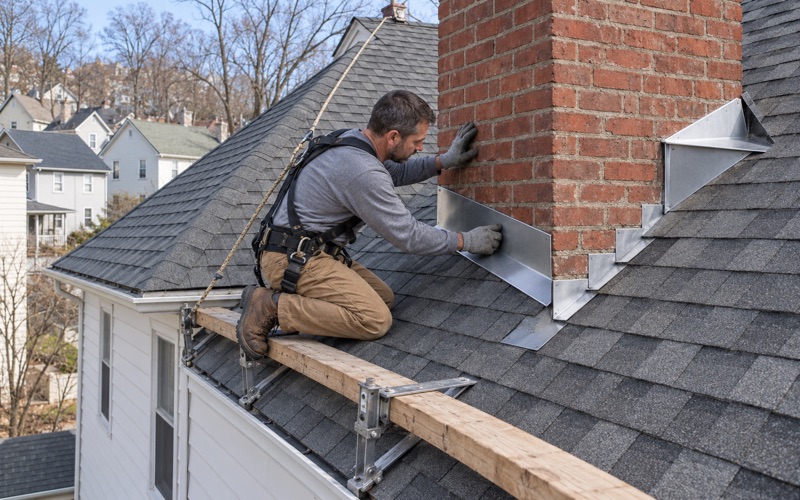
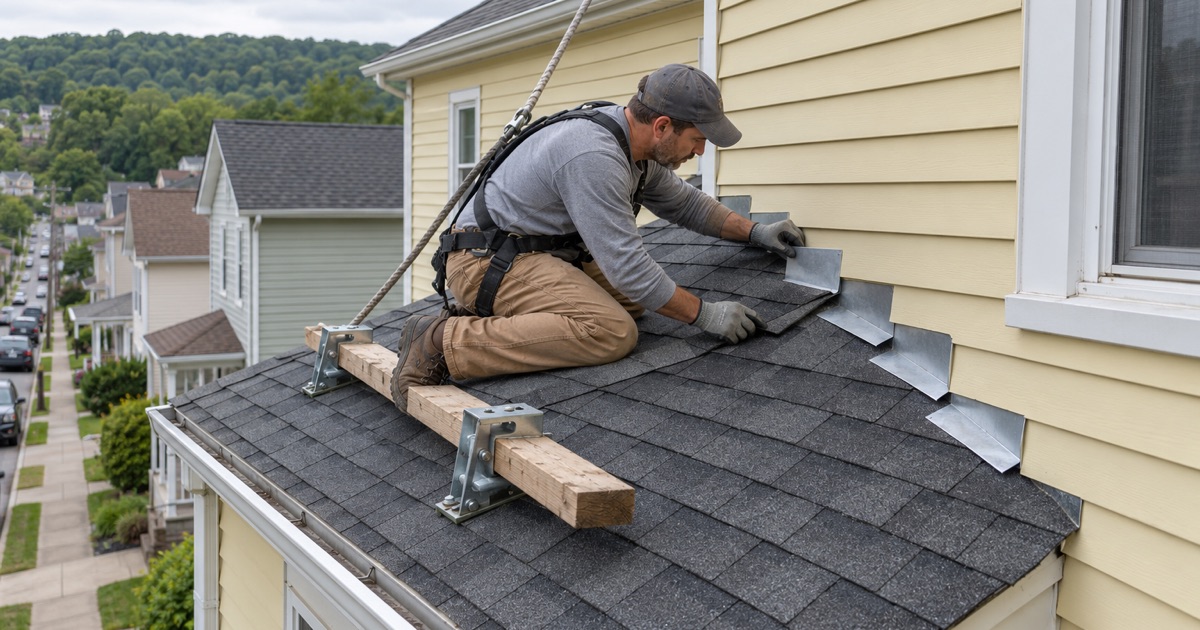
Step flashing, counter flashing and chimney flashing are replaced with the roof rather than reused under new material. On older chimneys that may mean a new cricket on the uphill side, so water is steered around the masonry instead of pooling against it. Drip edge goes on at the eaves and rakes.
Gutters and downspouts are sized and pitched as part of the same job. A new roof that sheds water faster than the gutters can carry it simply moves the problem to the fascia and the foundation. We plan the drainage with the roof so the two work together from the first rain.
Storm damage and a clean yard
After a storm, we photograph the damage and write it up so the owner can file their own claim. If the owner asks, our crew will meet the insurance adjuster on site and point out what we found. We do not negotiate the claim; that stays between the owner and the insurer.
The Lackawanna River runs through the borough, and sections of it are classed as Class A Wild Trout Waters. That is one more reason we clean the driveway, yard and gutters at the end of every work day. A magnet sweep picks up loose roofing nails, so old shingles and fasteners end up in the dumpster rather than in the grass or the street.
- 20+ Years Roofing
- Free Written Estimates
- Repair Before Replace